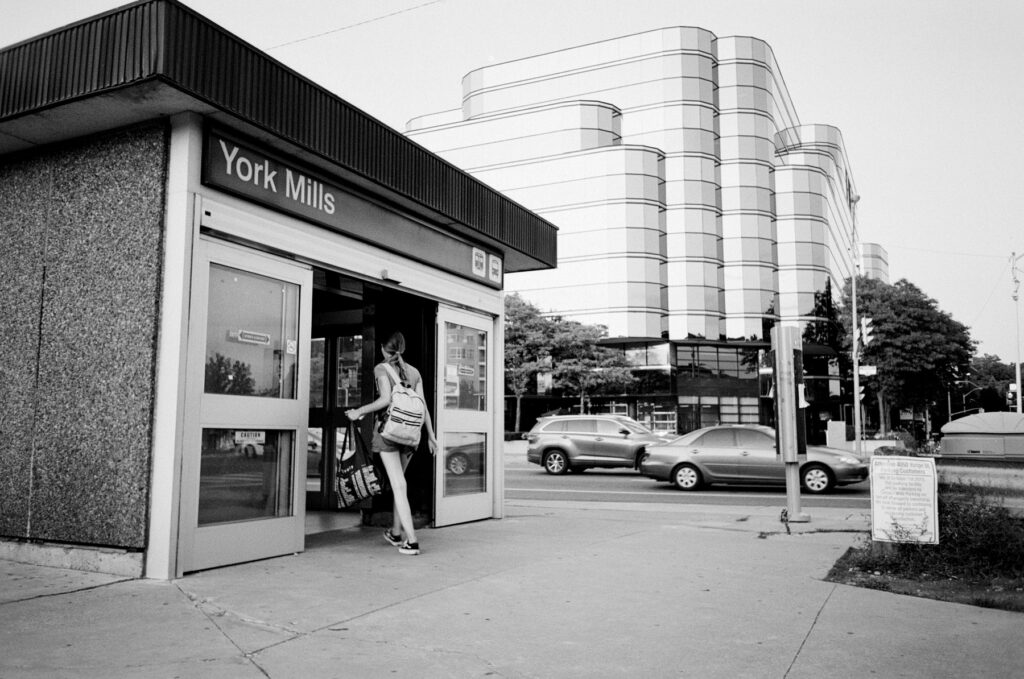
Leica ii Summar

Leica ii D (1932) & Leica Summar 50mm f2 (1934 ) – NYC Street Shooting

By Scott Ferguson

In the waning days of Summer, 2026, I decided to take a flyer on an early Barnack Leica. I was intrigued by the history of the pioneering 35mm rangefinders, and perhaps attracted by the distinctive look, especially the black enamel models.

After a few weeks of eyeing different ‘classic’ packages that paired an early Barnack with an Elmar 50mm f3.5 at moderately premium prices for cameras of that ilk, I decided to go a la carte and bought a reasonably priced 1932 Leica ii D in black.  After some R&D into the lenses of that era, I opted for a nickel 1934 Leica Summar 50mm f2.  My sense from reviews of 1930’s Leitz lenses, including Hamish’s here on 35mmc, was that the Summar might offer something a little more distinct in character compared to my other 50mm lenses, hopefully in interesting ways.

When the camera and lens arrived, I loved the look of the black enamel with bits of brass peaking through the 94 year old paint, and the soft warm glow of the 92 year old nickel of the Summar.  It was instantly the coolest looking camera in my collection.  But would it work?
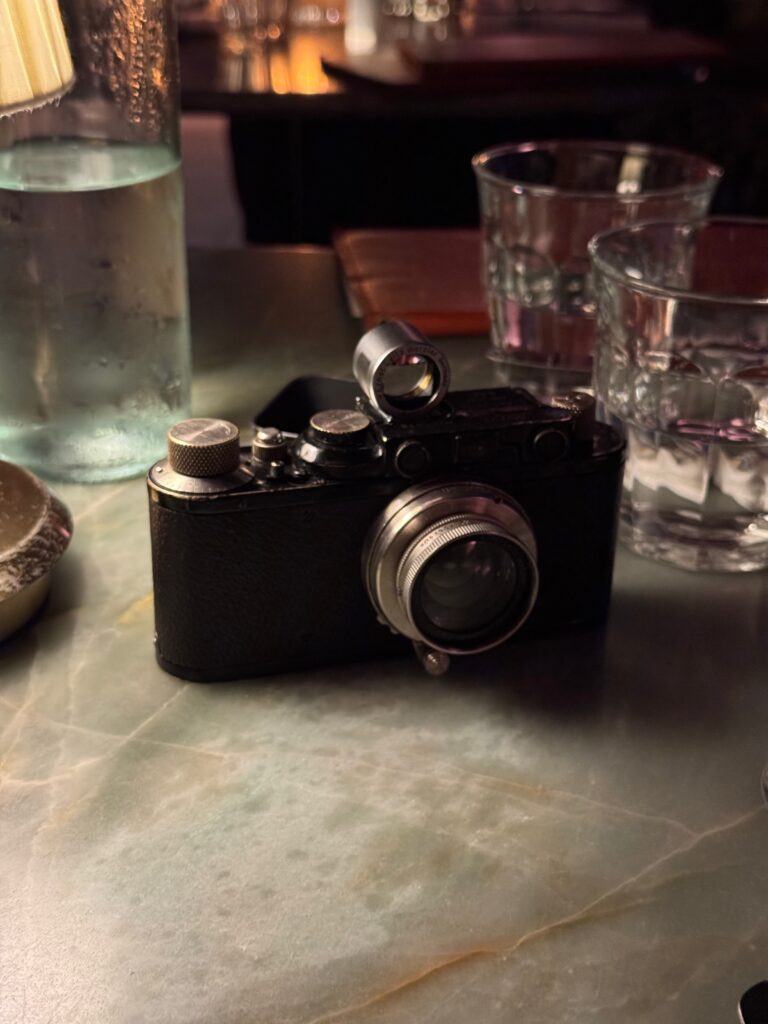
As soon as I could, I took them out to shoot a couple of rolls to make sure it was all functioning properly.  My first roll was Tri-X, thinking a classic stock with a bit of grain might pair nicely with the vintage/antique camera & lens.

I wasn’t disappointed!
Leica ii Summar
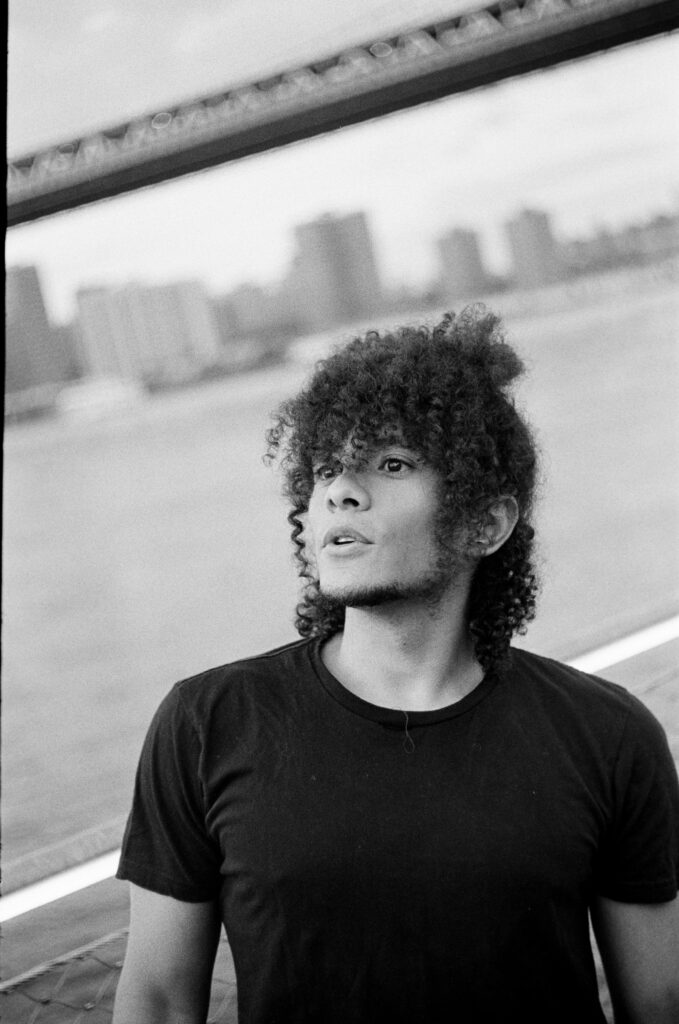
SIMON, Leica iiD, Leitz Summar 50mm f2, Kodak Tri X

About 200 yards from my front door in Brooklyn on a Friday evening toward dusk, I ran into Simon, a very interesting and highly photogenic young man.  He was a terrific subject — fun to shoot, fun to talk to, and interesting emotions and expressions seemed to flow unchecked as I shot about a dozen frames with him.  Through the finder, I knew they were going to be good photographs as long as there was nothing technically wrong with the camera & lens.  I was delighted when they came back from the lab, and this is my favorite.  In this dusky light I love the flattering softness of the lens and the warm grain of Tri-X, that combination definitely reads ‘vintage film.’

I’d love to share more photos from that first roll with Simon, but for the purposes of this post, I’m limiting myself to a single image per roll for my “Summar Grand Tour.”
Leica ii, Summitar
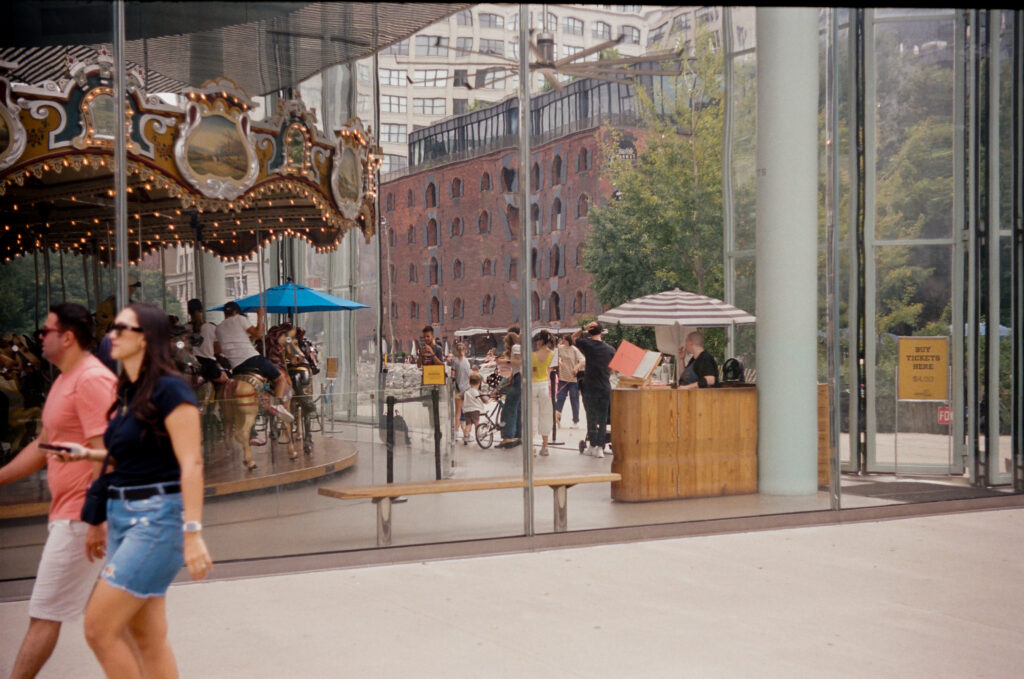
JANE’S CAROUSEL, Leica ii D, Letiz Summar 50mm f2, Portra 400

The next morning, I tried a roll of Portra 400 to see how the Summar rendered in color.  Not all film expeditions end up being equal, especially when I’m trying to shoot out a quick roll or two to determine if a piece of gear I’m trying out is working.   I didn’t have quite as much luck finding an amazing subject as Simon and it wasn’t my favorite conditions shooting much more stopped down in stronger light — but at least everything is working as it should.

Leica M3
PAULA, Leica iiD, Leitz Summar 50mm f2, Kenmare 400

Kenmare 400  is a a stock I rate very highly for a fine grained 400 ISO, especially considering its bargain price point.    This shot of Paula was taken a few hundred yards further along the Brooklyn waterfront from from the carousel.  I think Kenmare 400 shot through the Summar is pleasingly sharp with a nice dynamic range from deep black to bright white, but maybe the look is a little more ‘familiar’ than the shots of Simon on Tri-X.

After rushing those early rolls through the lab, I was happy to see that the basic functions of my 1930’s kit were fully functional.  Between the strange f stops on the Summar (f2, 2.2, 3.2, 4.5, 6.3, 9 & 12.5) and the equally unfamiliar frame rates on the Leica ii, (Z, 20, 30, 40, 60, 100, 200, 500) translating meter readings was a bit of a ‘horseshoes and hand grenades’ exercise of trying to get as close as I could, which seemed to work out just fine.  Helpfully, the lens doesn’t have click stops, so I could dial in to get what felt like f2.8 or f4, etc.

Typically for me, I decided to spend my next couple of photo outings trying out a wide variety of film stocks to see what combinations were the most promising/exciting.
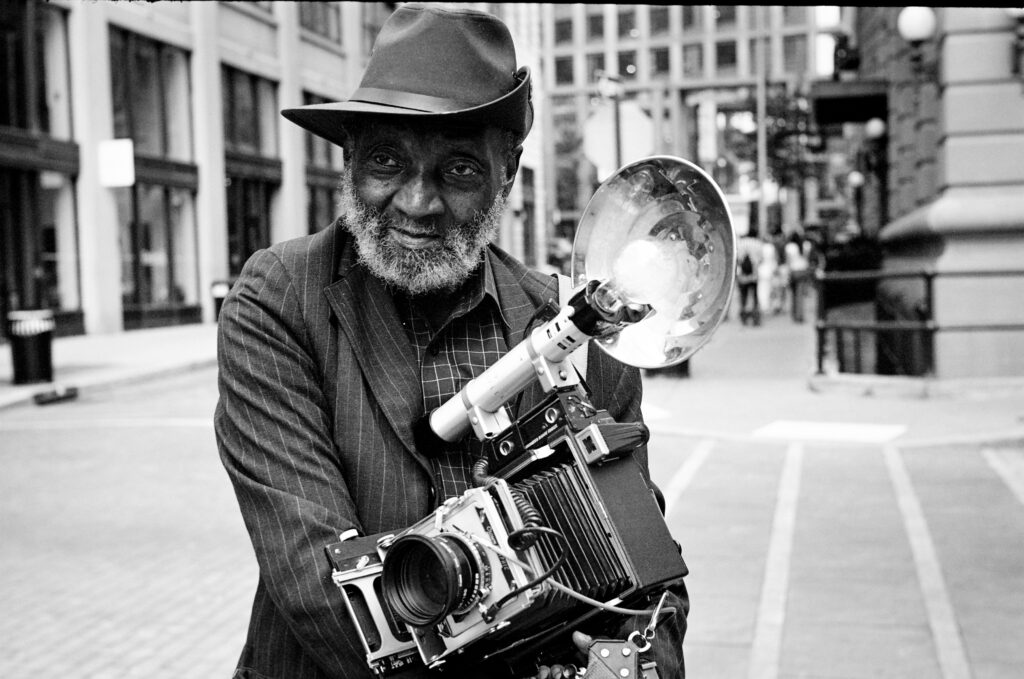
Leica ii Summar
LOUIS MENDES, AMERICAN PHOTOGRAPHER, Leica iiD, Leitz Summar 50mm f2, Ilford XP2

Ilford XP2 is an unusual film, a very fine grained b&w stock that creates a monochrome image using color chemistry that can be processed with C41 color developers.  Some of my favorite early Canadian landscapes were using XP2, but after a while, I found that it started to look a little ‘digital’ to my eye when paired with very refined glass, like my Zeiss Hasselblad lenses or my Leica Summilux ASPH.   I love this shot of Luis Mendes, a legendary NYC street photographer who roams the city selling instant portraits with his Speed Graphic.  He uses old school single-use metal filament flash bulbs just like Weegee did with his Speed Graphic, apparently he found a warehouse of them somewhere in Canada.  I hope I can share this image with Luis some day soon, and also sit for a portrait by him.

Although XP2 with a 1930’s Summar is not exactly a classic combination that would appeal to Barnack purists, I think it works!
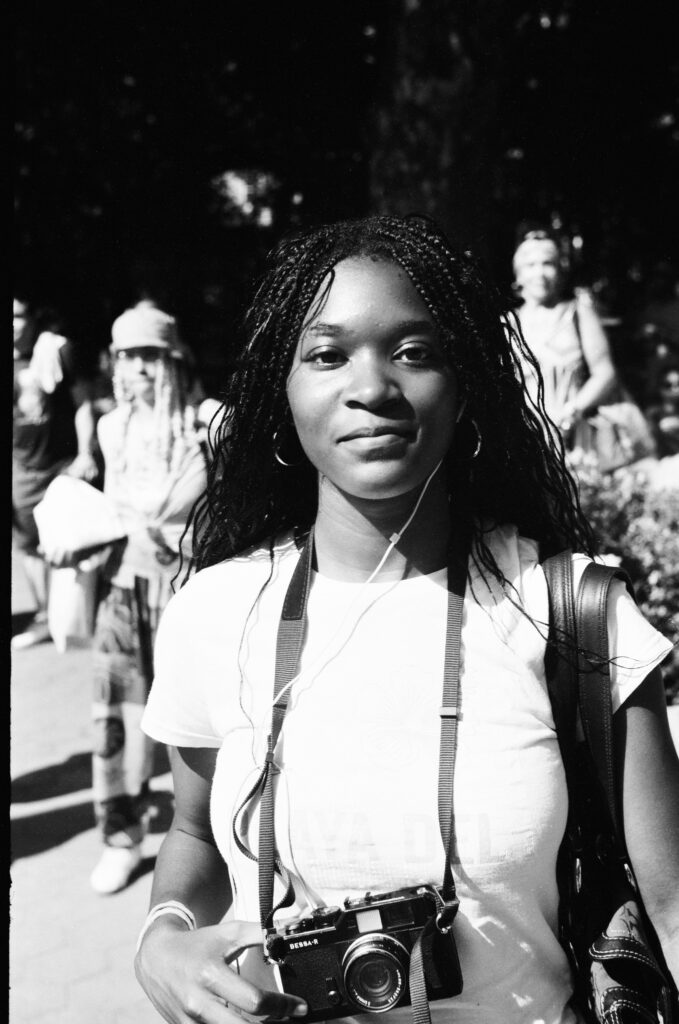
Leica ii Summar
ANGELA, Leica iiD, Leitz Summar 50mm f2, Rollei Retro 80S

Rollei Retro 80S is a very high contrast stock that can be quite tricky with modern lenses that also tend toward high contrast rendering.  A lot of my shots on Retro 80S go so far into deep black that the image gets kind of lost in the inky depths, with very little transition from deepest black to bright white.

One of my emerging theories is that pairing these high contrast films with older low contrast lenses kind of brings out the best of both film and lens.  Higher contrast film stocks make a softer lens render a sharper looking image, and the lower contrast of the lenses add more subtle shading that gets pushed to the extremes of the grey scale on more modern lenses.  This shot of Angela, a very nice young photographer who was out on a very sunny day her Voigtlander Bessa seems to fit that emerging theory.  You can see that ‘black glow’ in the deep shadows around her face and hair and the background, but there is plenty of nice subtle shading on the skin tones.  I really like Retro 80S with the Summar.

Leica ii Summar
Svema Foto 100

My next roll, on the same day in the same location was Svema Foto 100, another fine grain high contrast stock from Ukraine.  I like this shot, which is hitting the extremes of high contrast based on the strongly side lit angle I chose, but I think Svema Foto 100 might pair better with some of my other lenses compared to Retro 80S.
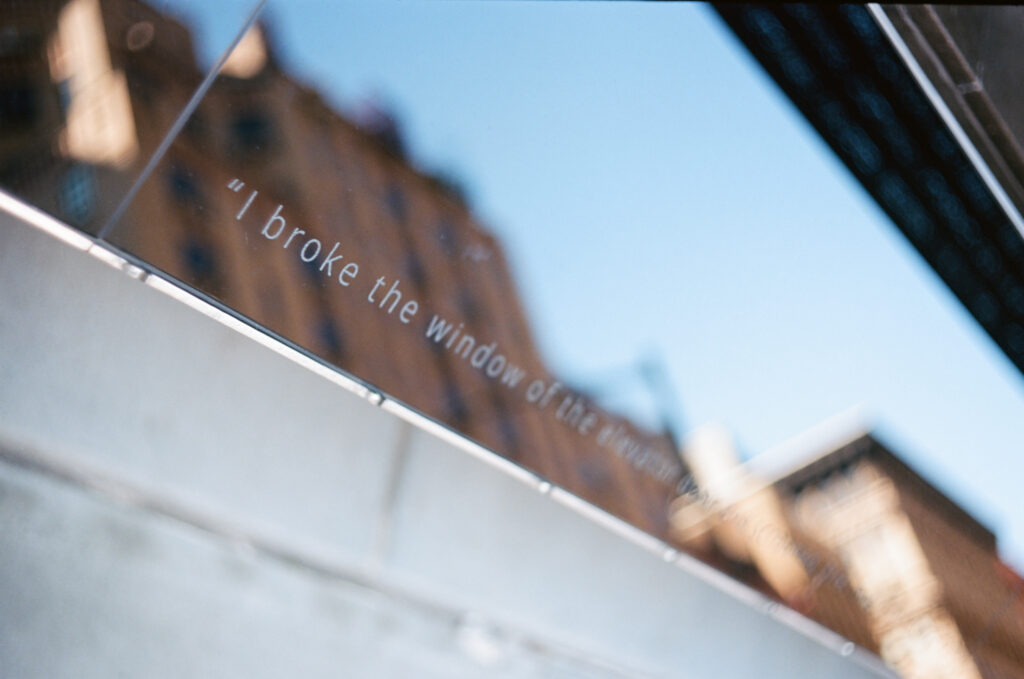
Leica ii Summar
TRIANGLE SHIRTWAIST MEMORIAL, Leica iiD, Leitz Summar 50mm f2, Kodak Ektar

Next up, I made another attempt at shooting color with gear that predated the introduction of Kodachrome, the first widely marketed color film stock, by a couple of years.  I like the way Ektar looks on this shot that mixes the almost abstract reflections of buildings and sky against the text of the memorial on polished black granite.  Unfortunately, the rest of the roll was less successful, in part due to a very challenging shooting situation — a punk concert in heavy backlight with deep shade from the trees in Tompkins Square Park.  It was tough shooting under the best conditions with very dynamic fast moving subjects in low light,  but the inherent challenges were compounded by a light meter mistake, where I was taking readings as if I had the ‘high slide’ in my Sekonic 398 incident meter and ended up underexposing most of the roll.

For the shots that did work from that roll, it feels like Ektar might have a little bolder color rendering than the Portra stocks.   I’ll have to give it another try!
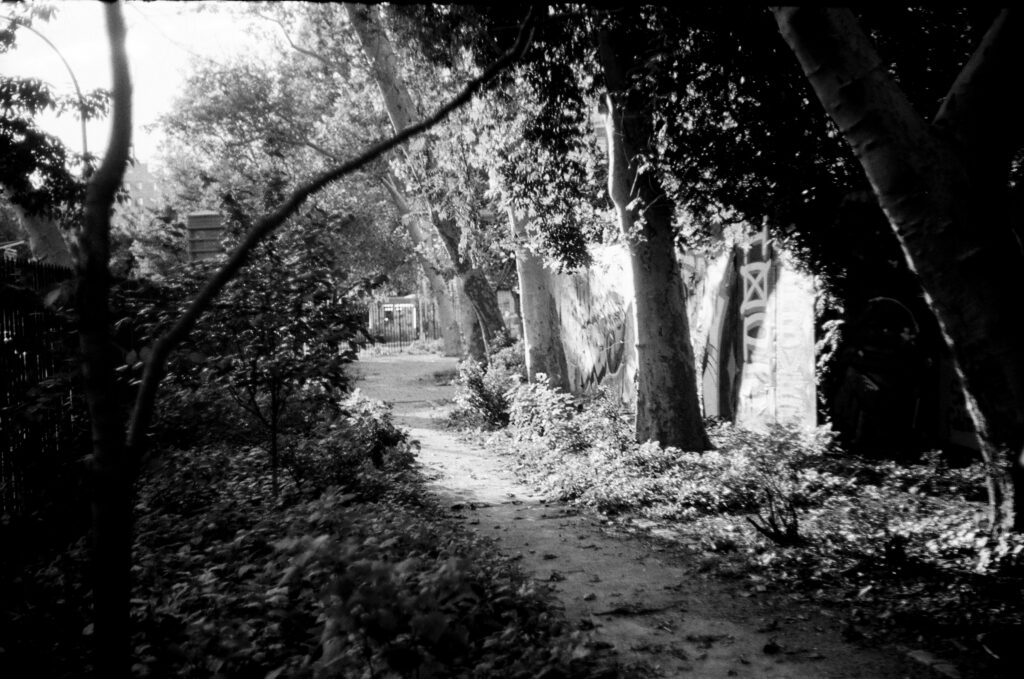
Leica ii Summar
FIRST STREET GREEN, Leica ii D, Leitz Summar 50mm f2, Ilford FP4

I had better luck on my next roll, which was Ilford FP4, both because I managed to correct my metering mistake, and because FP4 pairs very nicely with the vintage gear.  My favorite was this shot of the First Street Green Art Park on East Houston Street.  I thought the light and shade of this alley of trees was gorgeous.  Perhaps an homage to Eugene Atget, this shot has a very timeless end evocative look to me, and feels like it could have been taken when the camera and lens were new.

Leica ii, Summar
PARROT MAN, Leica ii D, Leitz Summar 50mm f2, Rollei Blackbird

My next stop on the “Summar Grand Tour” was Rollei Blackbird, which is a slow (ISO 64) fine grained very high contrast film that has a strong ‘family resemblance’ to Retro 80S, including some of the high risk/high reward qualities working with such a high contrast stock with sometimes overwhelming blacks.  This particular roll ended up getting fogged when the film detached from the cassette, when I opened the bottom of the camera I saw the film in the take up reel.  Fortunately there was a small film lab right on the exact block on Avenue A where I happened to be and they helped me unload with their darkroom set up, salvaging the early shots from the roll.

This shot is of the man with the parrots is my favorite and has a very interesting look, with micro shifts in sharpness within his face, due to the narrow depth of field using a slow stock.  The left side of the frame has more ‘3D pop’ than I saw on other frames with the Summar.  I’ll definitely want to try another full roll of Blackbird, and hopefully won’t fog the next one!
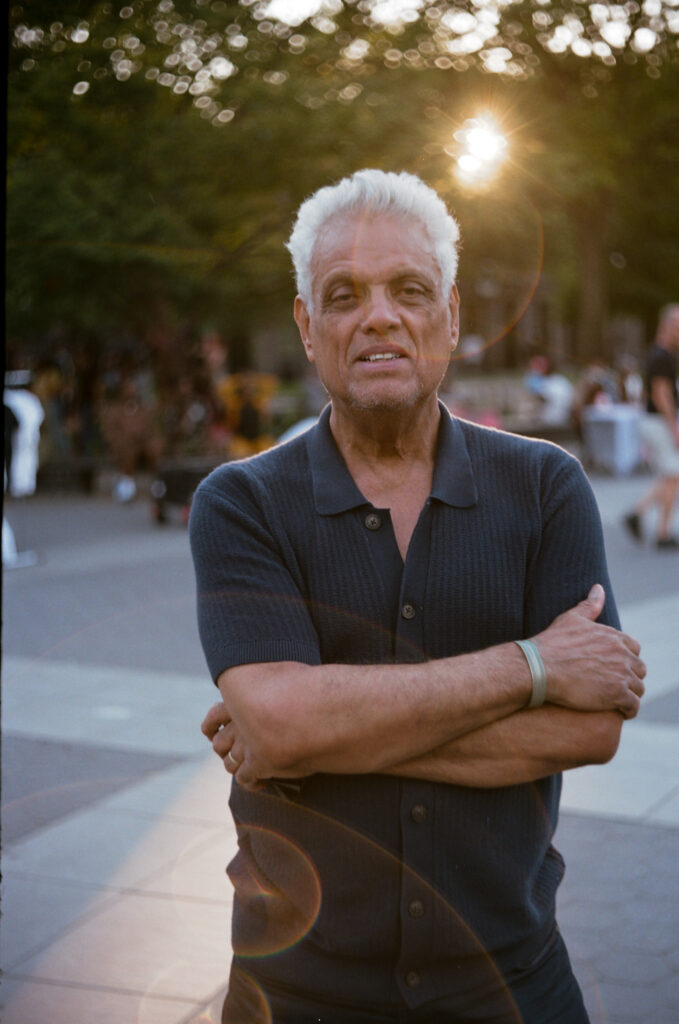
Leica ii, Summar
CARLOS, Leica iiD, Leitz Summar 50mm f2, Portra 160

On Portra 160 in backlight, I like the interesting circular rainbow flares that add a bit of nice vintage character to the shot.  I suspect shooting with a  hood probably salvaged this shot from being completely dominated by flare.  Knowing the Summar’s reputation for flare in backlight, I bought a Summar hood in advance at the same time as the camera and lens.  After my first day of shooting I picked up a couple more accessories, including a lens cap, a couple of vintage E34 filters, and an inexpensive contemporary half case with strap loops — Leica didn’t start putting strap lugs on Barnacks until 1933.  With no filter or lens cap, on the first 3-4 photo outings, I carried the camera in my hand the entire time, as I didn’t want to risk anything rubbing against the soft uncoated lens.
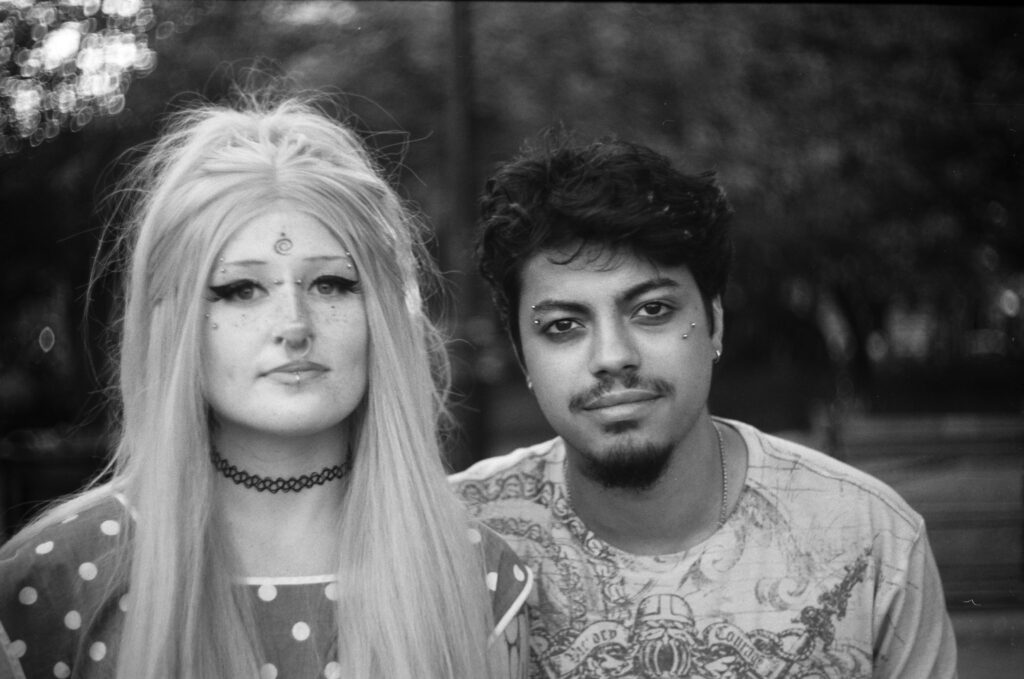
Leica ii Summar
BLESSING + FRIEND, Leica ii D, Leitz Summar 50mm, f2, Ilford Pan F Plus

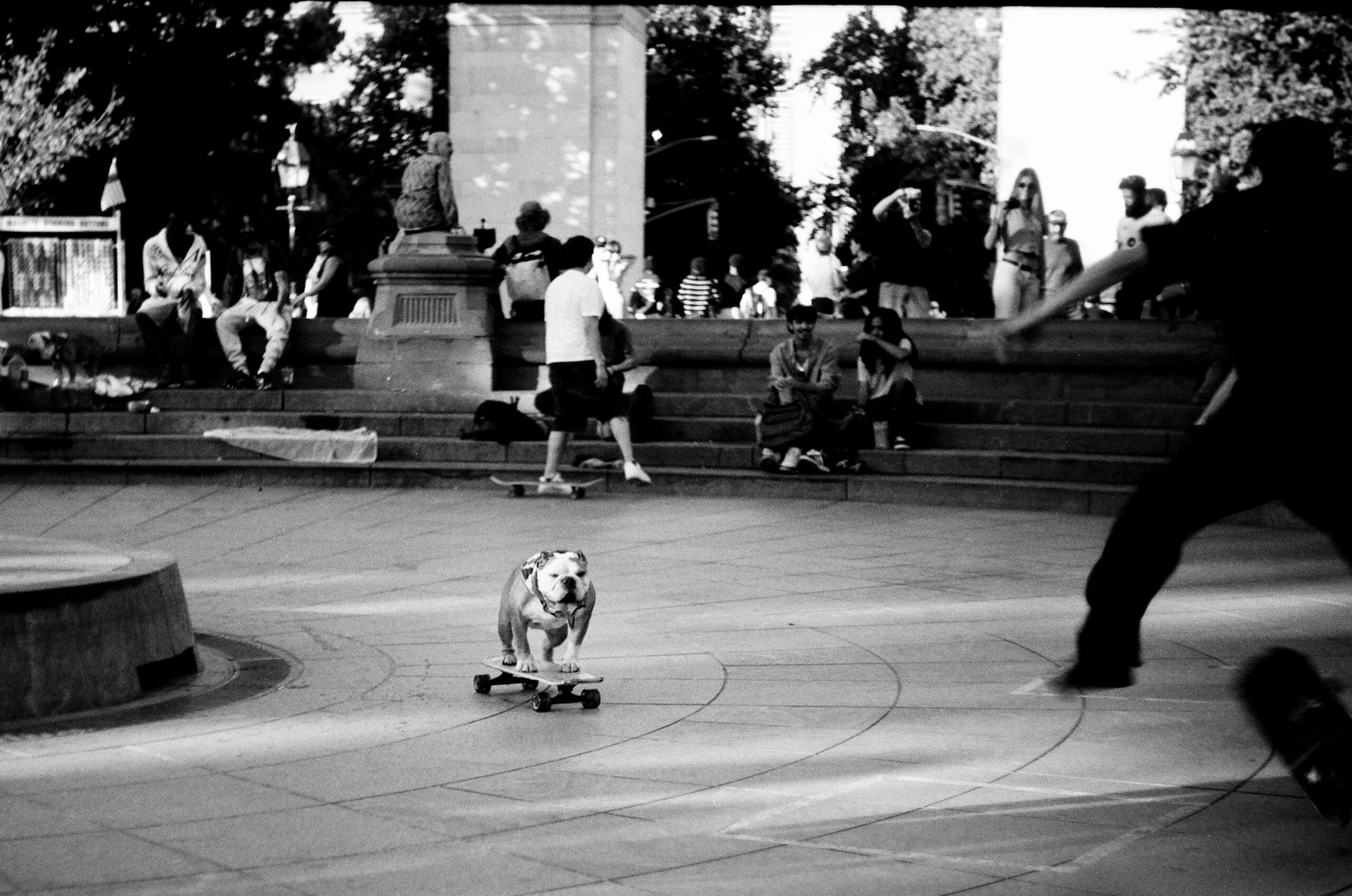
Ilford Pan F Plus is a very slow (50 ISO) fine grained black & white stock that came out in the 1930’s, whiich might be the closest I’ve come to the original Leica ii D shooting experience.  Despite small variations in sharpness between Blessing on the left, and her friend, I love the warm subtle shading of the skin tones which almost feel a little translucent,  maybe an early example of the famous Leica “glow.”  Based on shots like this one, and the featured image of the dog riding a skateboard, I feel like the Summar + Pan F Plus has tremendous potential.
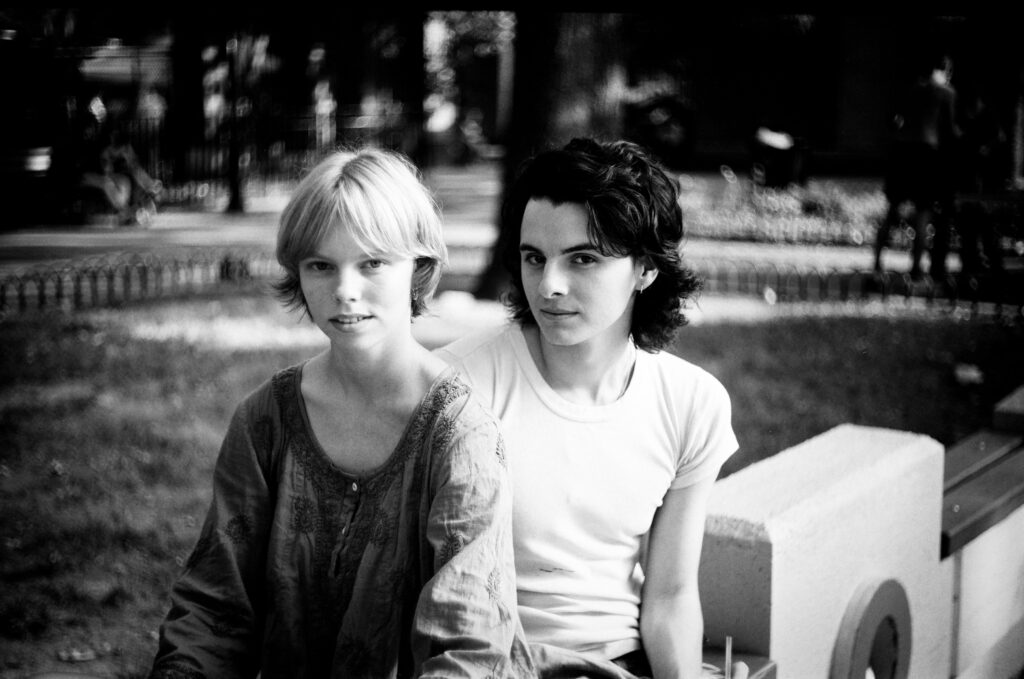
Leica ii Summar, yellow filter
AIDAN & MAYLA,  Leica ii D, Leitz Summar 50mm, f2, Ilford Delta 100

This shot of Mayla and Aidan, two young people I met in Tompkins Square Park is probably my favorite shot with the Leica iiD + Summar.  This two shot portrait feels almost painterly with the soft tones and shading between deep black and bright highlights.
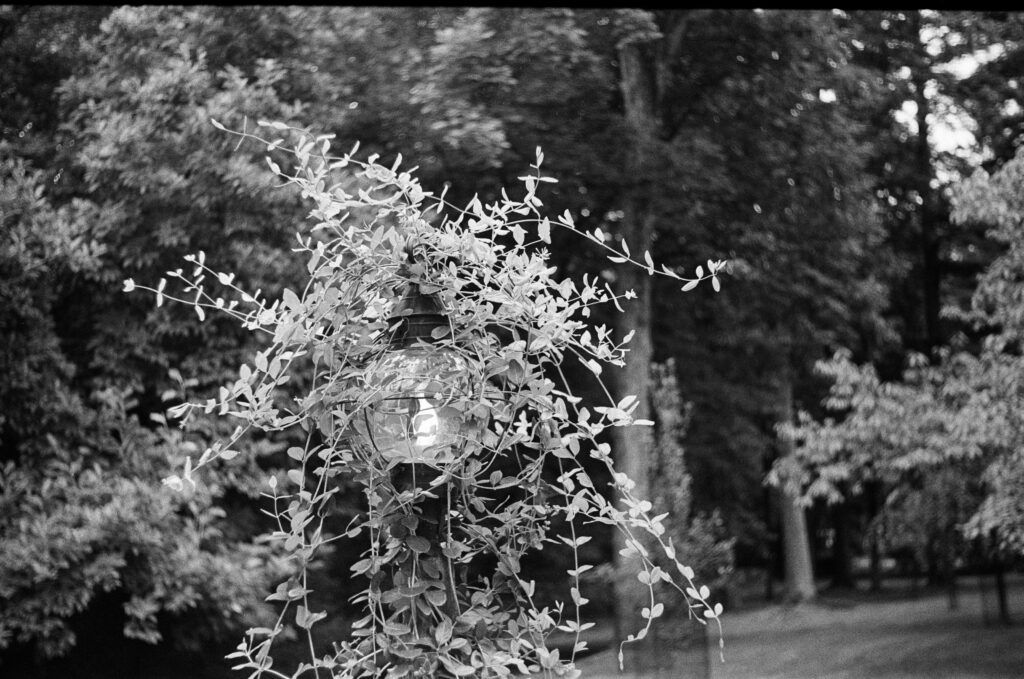
Leica ii Summar yellow filter
LAMP POST, Leica ii D, Leitz Summar 50mm, f2, Ilford HP5

This was the last shot on a roll that I started in the same park where I met Aidan and Mayla, that had a number of shots that will feature in an upcoming post.  My wife planted some red honeysuckle at the base of the lamp post that lights the flagstone path from our driveway to the front porch of our house.  There is something whimsical and a bit ‘fairy tale’ about the way the plant has grown up and around the lamp; it feels a bit magic, almost like something from Narnia.  And shooting with gear from 90+ years ago that still works and produces beautiful images also feels a bit magic.

Final thoughts on my ‘newest’ camera?

I absolutely love it!

This was not my first attempt at a Barnack.  In my first couple of months of shooting, I go the itch, and the local camera store in Calgary had a shelf of vintage gear, including a very nice looking 1954 Leica iiif in its original box with it’s case and an empty reusable film cassette if I fancied bulk rolling.  I bought it, with a 24 hour ‘no questions asked’ return policy in mind.  That happened to fall on a bitterly cold December weekend in Alberta, and I just didn’t love the experience.  I didn’t mind the rangefinder, but hated framing through the tiny viewfinder window, and it was fiddly to load the iiif.  One roll felt a little off when I was shooting in the frigid Canadian winter and came back mostly all black leader with about 5 or 6 photographs that were partial frames due to some kind of improper alignment or tension on the frame advance mechanics.  I returned the camera, but kept the LTM lens, a 1949 Summitar, which became my favorite Leica 50mm lens.

From the start, I felt completely differently about the Leica ii D.  Part of the appeal was undoubtedly the mystique of using the OG Leica rangefinder; the 1932 Leica ii D was the first model and year that Leica marketed a camera with built-in rangefinder optics.  Another major factor was how much more experience I’ve built up since winter 2024 and not being overwhelmed by the gear.  And again, while I was a bit indifferent to the looks of the mid 1950’s iiif, I instantly loved the Weimar era design and looks and patina of age of the iiD.*
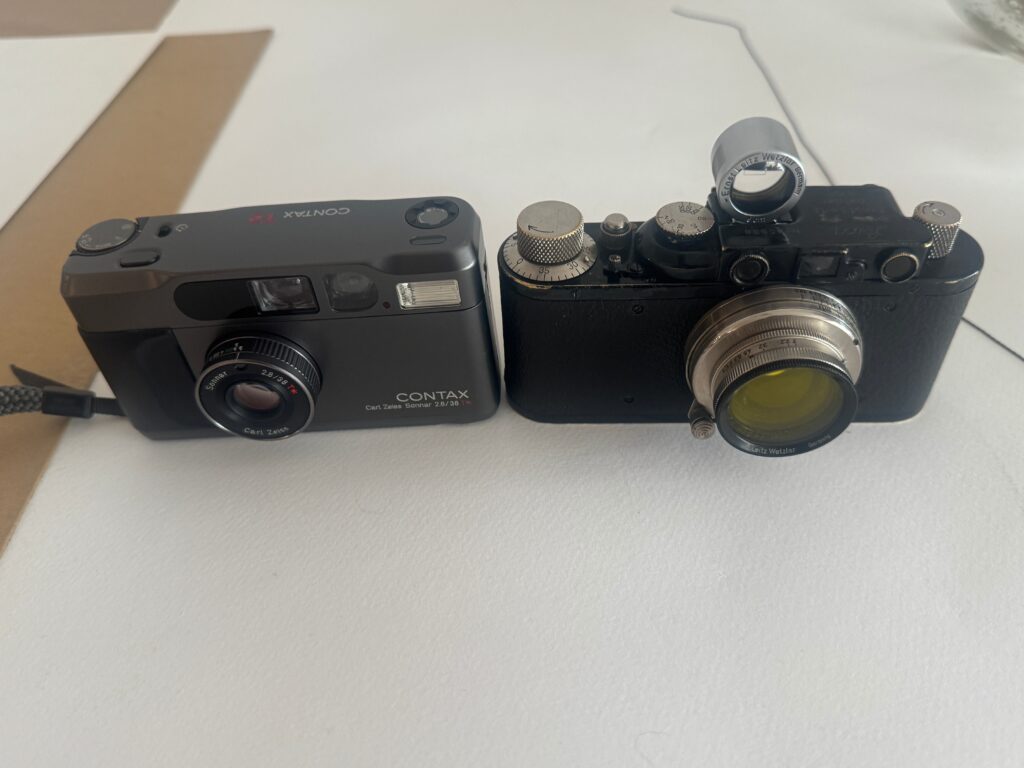
I am totally taken with the Leica ii, it has the least controls, options and range of choices of any camera I own, but it has exactly the ones I use about 90 percent the time on my other cameras, the essence of rangefinder photography distilled into its purest form.  I haven’t had the M3 out much since it arrived.  Now that I have it fitted with a caps and straps, it is fully as pocketable as my Contax T2, and for the foreseeable future it will be the default camera that I’ll want to have on hand just in case something cool happens.

Share this post:

About The Author

By Scott Ferguson
Scott Ferguson is an independent film and television producer known for such films as Brokeback Mountain, Only Lovers Left Alive and The People vs. Larry Flynt, and the television shows The Night Of and Succession. While working around cameras and recorded images for his entire career, shooting still photography with vintage all manual cameras is a new and very stimulating passion.
Read More Articles From Scott Ferguson

Find more similar content on 35mmc

Use the tags below to search for more posts on related topics:

Donate to the upkeep, or contribute to 35mmc for an ad-free experience.

There are two ways to contribute to 35mmc and experience it without the adverts:

Paid Subscription – £3.99 per month and you’ll never see an advert again! (Free 3-day trial).

Subscribe here.

Content contributor – become a part of the world’s biggest film and alternative photography community blog. All our Contributors have an ad-free experience for life.

Sign up here.

Make a donation – If you would simply like to support Hamish Gill and 35mmc financially, you can also do so via ko-fi

Donate to 35mmc here.

Comments

Ibraar Hussain on Leica ii D (1932) & Leica Summar 50mm f2 (1934 ) – NYC Street Shooting

Comment posted: 10/11/2026

Enjoyed this and seems your loving it!
Great street urban photos showing off NY
Pigeon man is my favourite
Ilford Pan F 50 is my favourite film of all time
Reply

Leave a Reply

Your email address will not be published. Required fields are marked *

Scott Ferguson replied:

Comment posted: 10/11/2026

Thanks Ibraar! I really enjoy shooting with the Leica iiD, and love the Summar! I also love Pan F Plus, but don't always feel confident shooting such a slow stock -- but on the right day and the right time of day, it can be magnificent, and looks really great on vintage glass. Best to you, s

Reply

Leave a Reply

Your email address will not be published. Required fields are marked *

Martin on Leica ii D (1932) & Leica Summar 50mm f2 (1934 ) – NYC Street Shooting

Comment posted: 10/11/2026

Great portraits and scenes. Very enjoyable!
Reply

Leave a Reply

Your email address will not be published. Required fields are marked *

Scott Ferguson replied:

Comment posted: 10/11/2026

Thank you Martin!

Reply

Leave a Reply

Your email address will not be published. Required fields are marked *

Erik Brammer on Leica ii D (1932) & Leica Summar 50mm f2 (1934 ) – NYC Street Shooting

Comment posted: 10/11/2026

Another set of wondeful street portraits, Scott!
Louis Mendes appears to be a very interesting character. Is he a warm personality? Or a sales person? Has he also found a warehouse full of peel-apart pack film? :-)
With Kenmare 400, you refer to Kentmere Pan 400? That's a very readily available stock here in Europe, inexpensive, and I use it a lot, following Jason Kummerfeldt's idea of pushing it to EI 1600 and pairing it with an orange filter which effectively brings it back to a 400-ish net rating.
Reply

Leave a Reply

Your email address will not be published. Required fields are marked *

Scott Ferguson replied:

Comment posted: 10/11/2026

Thanks Erik! Louis Mendes is an interesting character, and I've come across him a couple of times in my neighborhood. I wouldn't say he's either a warm personality or a sales person, he's a little like a man on a mission. He was been perfectly polite when I talk to him about his gear and he was interested in the iiD. He speaks with an air of authority about photographry and told me what stop to use (correctly) while I was fumbling with my meter. He asked if I wanted a photo but didn't press when I said I couldn't that morning (I didn't have my wallet and had to be somewhere or I may have tried to get some cash and gotten a photo. Yes, that's Kentmere PAN 400. I like Kentmere very much too, and feel like it's a great bargain stock and very reliable. The roll I shot with the Summar was in pretty strong mid morning light, and so probably not as interesting as a lot of the other stuff I shot for this post in late afternoon light at wider apertures. Interesting idea shooting with the orange filter pushed 2 stops to land back at a 400 net. I may have to try that some time!

Reply

Leave a Reply

Your email address will not be published. Required fields are marked *

David Rusling on Leica ii D (1932) & Leica Summar 50mm f2 (1934 ) – NYC Street Shooting

Comment posted: 10/11/2026

Excellent article, I enjoyed reading it. I agree with you on the 'squinty' viewfinder/rangefinder arrangement on the Leica IIIf. I use the SB001 viewfinder on mine and that helps but I prefer the separate viewfinder and rangefinder of the earlier Leicas.

Also, your Summar is giving better results than my 1933, although I did get lucky once - see https://www.35mmc.com/08/11/2026/triumph-motorcycle-photo-of-the-year-2026/
Reply

Leave a Reply

Your email address will not be published. Required fields are marked *

Scott Ferguson replied:

Comment posted: 10/11/2026

Hi David, Yes, I thought putting the infinitesimal viewfinder right next to the rangefinder on the later Barnacks was a step backwards from having them an inch or so apart on the earlier Barnacks, but I'm a dedicated external viewfinder shooter, even on the M3, and use an SB001 almost all of the time when shooting, even with a 50mm. My process with a range finder is to kind of 'code switch' from thinking about the technical aspects like depth of field when I'm metering and setting the aperture before I raise the camera, then focusing and general framing with the rangefinder, and then I put all of the technical thoughts aside when I switch to the brightline viewfinder and try to make my mind receptive to the mood and emotion and connection with the subject, which determines when I press the shutter. For some reason, I didn't have the SB001 on the iiD the day I ran into Louis Mendes, so that is probably the only shot I took through the internal viewfinder on the iiD. I'm not unhappy with the composition or the mood I caught in that moment, but it definitely felt different than the familiar brightline experience.

Reply

Leave a Reply

Your email address will not be published. Required fields are marked *

Scott Ferguson replied:

Comment posted: 10/11/2026

PS -- I loved your motorcycle shot. It's possible I may have gotten a cleaner copy of a Summar, but I'd highly recommend getting a hood, and maybe picking a high contrast stock, which can help offset a bit of the softness of a 1930's fast 50mm when shooting at wider stops . Almost everything on this post was shot with a hood, and when I shot a handful of shots in backlight without a hood, the results were not great with a fair amount of veiling glare.

Reply

Leave a Reply

Your email address will not be published. Required fields are marked *

Sasha Tsyrlin on Leica ii D (1932) & Leica Summar 50mm f2 (1934 ) – NYC Street Shooting

Comment posted: 10/11/2026

What a great looking combo! And the lens is plenty sharp without loosing a vintage charm. Cool shots. Mandez is my fave, he has such a face.
I have seen him around. This article makes me want to get a Barnack again:)
Reply

Leave a Reply

Your email address will not be published. Required fields are marked *

Scott Ferguson replied:

Comment posted: 10/11/2026

Hey Sasha, Thanks so much! Yes, I'm pretty happy with my Summar -- I may have gotten lucky to have gotten one that is in pretty good shape over ebay. I really like the personality of the lens and glad I got it over the more classic Elmar 3.5 so far -- the extra stops to shoot at f2 help and being an early fast uncoated 50mm probably contributes to the personality that I enjoy, which also feels different from any of my other lenses in a good way. I love shooting with the iiD! I did have to send mine to the shop because I had a jam from a little sliver of film that got caught in the shutter because of a little slip when I trimmed the leader, so I'm without mine for the moment. Since then I picked up an Ablon film trimming guide, so hopefully that won't happen again when I get it back!

Reply

Leave a Reply

Your email address will not be published. Required fields are marked *

David Pauley on Leica ii D (1932) & Leica Summar 50mm f2 (1934 ) – NYC Street Shooting

Comment posted: 10/11/2026

Welcome to the early Barnack Club, Scott! Your digital capture of the camera sitting on the concrete counter or bar beautifully illustrates the romance of these old worn black enamel bodies. They have something that the technically superior Ms lack. I've never shot a Summar, but am very impressed with the character it brings to your compositions. The "first street green" shot could easily have been made a hundred years ago, but the camera and lens also shine in your portraits. The one of Louis Mendes is a stunner. Do you keep a yellow filter permanently attached to the summar?
Reply

Leave a Reply

Your email address will not be published. Required fields are marked *

Scott Ferguson replied:

Comment posted: 10/11/2026

Hey David! I wouldn't be in the early Barnack Club if it hadn't been for your inspiration! I loved the look of your Barnacks, and was very intrigued that you liked them enough to switch more or less completely over from your M3's, especially after having failed to love the iiif I tried in Canada. But I'm a total convert, although mine is now in the shop, so I'm back to shooting with the M3 for the moment. I am extremely happy with the Summar, and it really shines with the right stocks and the right lighting. I didn't have any filters when I shot the first couple of rolls, and then I picked up a couple on ebay, along with a lens cap and a half case, since the camera came out before they thought of adding strap lugs. I can't remember exactly when I started shooting with the yellow filter on, but I know I had it on for that two shot of Aidan and Mayla, which is on my 'shortlist' for photo of the year, along with Louis Mendes. I have a feeling I'll probably use the yellow filter more often than not when shooting with the Summar.

Reply

Leave a Reply

Your email address will not be published. Required fields are marked *

mike tynan on Leica ii D (1932) & Leica Summar 50mm f2 (1934 ) – NYC Street Shooting

Comment posted: 10/11/2026

From my seat this camera -lens is a natural fit ..to me...it just works, is straight forward and always does the job... clearly my favorite. I got it in 1964 and have used it since. It is the first camera I have owned. I have never thought of it as being old or harking back to something...it just fits and does the job...normal and usual. Having and using this camera as my baseline and standard does make me see many newer cameras as 'better' but often, for me, as just a bit too complex and distancing. After reading your article you made me think about why I find myself in concert with this camera...(I have many others cameras as well).... maybe I find it a simple, direct, straight forward link between my thought and my photo . Regardless, your first experiences have been rewarding, off to a great start and building. I suspect if you just use it, yours too will soon become a trusted friend.
Reply

Leave a Reply

Your email address will not be published. Required fields are marked *

Scott Ferguson replied:

Comment posted: 10/11/2026

Thanks Mike! Yes, there is something really interesting about the simplicity of the early Barnacks, with it's very limited set of controls and options, but all of the ones I use for most of what I shoot -- I rarely need to shoot over 1/500th, or do long exposures on a 35mm rangefinder, so it does everything I need for walking around New York City to shoot street and street portraits. It was not hard to switch from an M3 to the iiD, as the process of focusing, framing and shooting aren't dramatically different. I think the Barnack may become my default 'grab a camera when I leave the house' camera, because of it's compact size, and I've done some shooting expeditions with the iiD loaded with b&w and the M3 loaded with color when I want that kind of optionality. Sadly, mine is in the shop for a while awaiting a repair, but I can't wait to get it back and start to really get to know it! Meanwhile, I think the Summar will be a fun option for certain kinds of shooting situations when I want some vintage personality.

Reply

Leave a Reply

Your email address will not be published. Required fields are marked *

Neal Wellons on Leica ii D (1932) & Leica Summar 50mm f2 (1934 ) – NYC Street Shooting

Comment posted: 10/11/2026

Thanks for all the work you put into this. It is one of my favorite 35mmc posts. I'm partial to black Barnacks and love my Summar as much as you love yours. Regardless of my bias, your portraits are absolutely wonderful and it is fantastic that you tried so many film stocks to really judge your beautiful camera. Be careful though, if you have any tendence to G.A.S., there may be more black Barnacks on the horizon. I have ended up with five of them, most with Elmars and copies, because I like the size of the kit. I keep each loaded with a different film, even infrared. My 1A, 1C and Standard are even more fun with no rangefinder. I don't uses a meter when I'm outside either. They have become point and shoots with Sunny 16 and Zone focusing.

I'm really looking forward to your next post.
Reply

Leave a Reply

Your email address will not be published. Required fields are marked *

Scott Ferguson replied:

Comment posted: 10/11/2026

Hey Neal, Thank you so much for the kind words! And I'm so happy you like the photos. Five Barnacks! Ha! My biggest GAS affliction seems to be a weakness for 50mm lenses -- I picked up an 11 o'clock 1932 Elmar f3.5, to go with the 1934 Summar f2, a 1949 Summitar f2, a 1950's Summarit f1.5, a 1950's Canon f1.4 LTM, a 1960 Summicron f2 Dual Range, and a 21st Century Summilux f1.4 ASPH, and an Omnar Bertele f2. My favorites are probably a toss up between the Summitar and the Bertele, but the Summar is up there in the top table, and I'm really liking the Canon, which might be my favorite option for shooting color film. I still use the meter, but am getting a little freer about stopping up and down to adjust for brightness and shadow once I set a base line exposure for the overall conditions. Hamish is a fan of zone focusing with a Leica Standard -- I tend to like shooting at pretty wide apertures on 50mm's for the majority of what I do. There have been a few occasions like very dynamic situations like street parties and protests when I'll try to zone focus with a wider lens like a 35mm, or a 28mm or even a 21mm, but I'm not as confident in shooting that kind of action and feel like I need to practice more in terms of finding compelling frames and timing to grab interesting moments. I'm much more at home doing my emerging style of 'high engagement' street portraits like many of the shots in this post, and the 50mm feels like the perfect lens for that, where I'm at the perfect distance from the subject to have a rolling conversation while I'm shooting, and there is a nice separation between subject and background at most stops.

Reply

Leave a Reply

Your email address will not be published. Required fields are marked *

Eric Rose on Leica ii D (1932) & Leica Summar 50mm f2 (1934 ) – NYC Street Shooting

Comment posted: 10/11/2026

I always look forward to your articles/posts! Another great one, with lots of beautiful photos and great commentary.
Reply

Leave a Reply

Your email address will not be published. Required fields are marked *

Scott Ferguson replied:

Comment posted: 10/11/2026

Thanks so much, Eric! Best to you, s

Reply

Leave a Reply

Your email address will not be published. Required fields are marked *

Cem Eren on Leica ii D (1932) & Leica Summar 50mm f2 (1934 ) – NYC Street Shooting

Comment posted: 11/11/2026

Lovely.
Reply

Leave a Reply

Your email address will not be published. Required fields are marked *

Scott Ferguson replied:

Comment posted: 11/11/2026

Thanks so much!

Reply

Leave a Reply

Your email address will not be published. Required fields are marked *

Neil Lloyd on Leica ii D (1932) & Leica Summar 50mm f2 (1934 ) – NYC Street Shooting

Comment posted: 11/11/2026

Another great series Scott, I enjoy your writing as much as your photos. The Pan F combination hits the sweet spot for me, not very eloquent I know but the look just works.
Reply

Leave a Reply

Your email address will not be published. Required fields are marked *

Scott Ferguson replied:

Comment posted: 11/11/2026

Yes, those shots on Pan F Plus are lovely -- the light was really nice that afternoon in the park, and I love the contrasting skin tones between Blessing (who was wearing a bright green wig) and her friend. I think that shot has some real "Leica glow" and is also the closest to a pure Barnack experience, shooting on ISO 50.

Reply

Leave a Reply

Your email address will not be published. Required fields are marked *

Steve Abbott on Leica ii D (1932) & Leica Summar 50mm f2 (1934 ) – NYC Street Shooting

Comment posted: 12/11/2026

I've also got a 1932 Leica ii in (very attractive) battered black, although from the serial number, mine was built as a "standard", so the rangefinder/viewfinder must have been a later factory upgrade. In fact I set out to buy a standard, based on an old posting of Hamish's (thanks for the GAS) - at the time at least - the ii was more affordable. Mine's mostly coupled with a Leitz 50mm viewfinder like yours (which is insanely bright!), and an Elmar 50/3.5 from 1934, which has an stupidly expensive tiny yellow filter permanently attached, and I mostly put hand-rolled Kodak XX (5222) through it. I've recently been using my rarely used 1936 Summar instead. It's optics are apparently made of very soft glass, invariably prone to "cleaning marks" (i.e. scratches), but mine is very clean and has obviously been protected throughout it's long life. I've added a SOOGZ filter adapter (fairly cheap when I bought it, now not so much), together with the yellow filter (although not now, as I've got some colour in currently) and IROOA hood more usually used on my other screw mount lenses on a iiig. This is the oldest, simplest and most used of my cameras, and for many years I carried it permanently in my trouser pocket; recently I sent it it for a CLA (even though it appeared to be working perfectly), and was told that internally it was full of fluff and dust, presumably from my pocket - I carry it in a bag now! My Summar is a little stiff and less positive to extend, compared with the Elmar, and I've had a few frames with weird but interesting focus/distortion as a consequence. Even collapsed, it's relatively bulky, but only vis-a-vis the Elmar, and thus not so pocketable anyway.
Reply

Leave a Reply

Your email address will not be published. Required fields are marked *

Scott Ferguson replied:

Comment posted: 12/11/2026

Interesting set up with the filter adaptor and the IROOA. I use the IROOA with my Summitar and filter adaptor and like it a lot, especially on a rainy day to keep droplets off the lense, but went ahead and picked up a SOOMP hood for the Summar to have the more vintage combo. While the Elmar is definitely more compact when retracted, I find the Summar perfectly pocketable if I take the hood off, even with the external viewfinder still on, but maybe I have bigger pockets? Good tip on the accumulated fluff and dust, though. I often carry my camera slung over my shoulder on a longish strap, and maybe that's safer in the long run. Many thanks! s

Reply

Leave a Reply

Your email address will not be published. Required fields are marked *

Jeffery Luhn on Leica ii D (1932) & Leica Summar 50mm f2 (1934 ) – NYC Street Shooting

Comment posted: 12/11/2026

Well, Scott,
If I ever get back to NYC, I'm going to stalk you and shoot over your shoulder. Man, you get the best street portraits! A dog riding a skateboard!?!?! And you got the shot with the slowest rangefinder on the planet? Really love the shot of Mr. Mendez with his Crown Graphic with the flash attachment. You get right in there at arms length.

As you know, I respect Leicas, but the Barnake ones are too difficult for me to focus. I wrote a 35mmc article about that. 'Being Un-Leica.' So what happens? A student of mine presents me with two, not one, two Leica IIIf cameras that he wants to trade for darkroom equipment. I showed him what Leicas are selling for and he points out the issues with his cameras. One has a bum shutter. Neither has Leitz lenses. One has a Canon 35mm and the other has a Nikon 50mm. Nice lenses. They both have some signs of wear, but the one with the good shutter has less. So I make the trade. Now I have a pair of Leicas that I belly-ached about. Maybe if I sent you one, you could shoot a roll for me. I'd process it and pretend I approached attractive people in NYC and got great shots of them. Good Idea, Jeff.
Reply

Leave a Reply

Your email address will not be published. Required fields are marked *

Scott Ferguson replied:

Comment posted: 12/11/2026

Hey Jeffery! Come on up! It would be a blast. I usually fly solo, but have had a lot of fun going out shooting with David Pauley up here, and also with my son who got me into photography. With David we tend to shoot in kind of elliptical orbits of each other, finding our own subjects and kind of checking in with each other. One time we did an expedition with his LF 8x!0 and I kind of focused on him and his camera, which was also a lot of fun, although he discovered a light leak on the old wooden body, so he didn't get useful shots to go with the ones I shot of him, otherwise that might have made for a fun joint post here on 35mmc. My son and I tend to shoot a little more side by side, which works well for the two of us, except maybe when did did some rock and roll photography where it felt like we both wanted to be shooting from the same position a lot of the time. We ended up kind of taking turns in that situation. I'd love to shoot a roll or two with one of your iiif's, especially since my iiD is in the shop! In terms of using the slowest rangefinder on the planet, and being a slow and bumbly photographer myself with any camera, I've kind of figured out a bit of a 'workaround' to deal with those issues, where I'll end up getting into a rolling conversation with the person that I'm shooting that has two purposes -- it buys me time to deal with my slow process of metering, focusing with the rangefinder, and then switching to the viewfinder to frame and find the moment to trip the shutter, and it loosens the person up so most of the time I get past the "mask" that people tend to put on for a snapshot and get something that feels a little more relaxed and personal and in the moment between us. In terms of shooting attractive people, obviously that is a pleasure in itself -- but I don't think that's actually what determines who I will connect with or not, which is a little bit more about finding a certain kind of extrovert personality and often someone who is a little bit unconventional in their persona, as opposed to just trying to find the most attractive person on the street or in the park. I think I've developed an instinct for finding people who are kind of putting themselves about in a way that invites attention, and those people tend to be quite open to spending some time getting their photo taken. As it happens, many of those people also happy to be pretty good looking. But my favorite shots are almost always ones where I kind of found a little spark of connection while we were talking and shooting that gave life to the frame. I think the Barnack plays a role in that, as it is a bit of an 'icebreaker' to show them the camera and tell them it's from 1932, et al, and people are almost always intrigued. That was definitely a big factor when I ran into the Luddites, like Aidan and Mayla, which is one of my favorite shots of the year.

Reply

Leave a Reply

Your email address will not be published. Required fields are marked *

John Duder on Leica ii D (1932) & Leica Summar 50mm f2 (1934 ) – NYC Street Shooting

Comment posted: 12/11/2026

I've owned a Summar on a Leica IIIa since I was at university - more than 50 years now. At the time I bought it, I was impressed by the way that 'not quite razor sharp' half-plate prints then led to equally not quite razor sharp big pull-ups.

Latterly, I've developed a love of shooting with the Summar on my Alpha 7, always at full aperture, which gives an almost 3-D look to the foreground subject. I reckon this is the result of the limited depth of field plus significant fall-off and reduced sharpness away from the centre of the frame. I't's rather beautiful...
Reply

Leave a Reply

Your email address will not be published. Required fields are marked *

Scott Ferguson replied:

Comment posted: 12/11/2026

Thanks John, I'm interested in the terminology about half plate prints and big pull ups, but don't know/use those terms. Interesting idea to shoot wide open with the Summar on the A7. We have an A7iii that my son uses for rock and roll shooting and low light. I haven't loved shooting digitally when I've tried it, but I could see having fun pairing a quality digital camera with an antique lens with a lot of personality. the Summar does have a good bit of 3-D 'pop' compared to some other Leica lenses I've used, but maybe not quite as much as the Summitar. But if you like 3D pop, I'd recommend something based on the Zeiss Sonnar formula -- I have an old Jupiter 8 and a new Omnar Bertele, both of which are using the Sonnar formula and have exceptional separation between subject and background, especially at full aperture. Some of my Bertele shots at f2 look almost like those folding greeting cards where the subject fold open to be a 1/2 inch in front of the background. I'd love to see some of your A7 photos! thanks, s

Reply

Leave a Reply

Your email address will not be published. Required fields are marked *

Leave a Comment

Leave a Reply

Your email address will not be published. Required fields are marked *