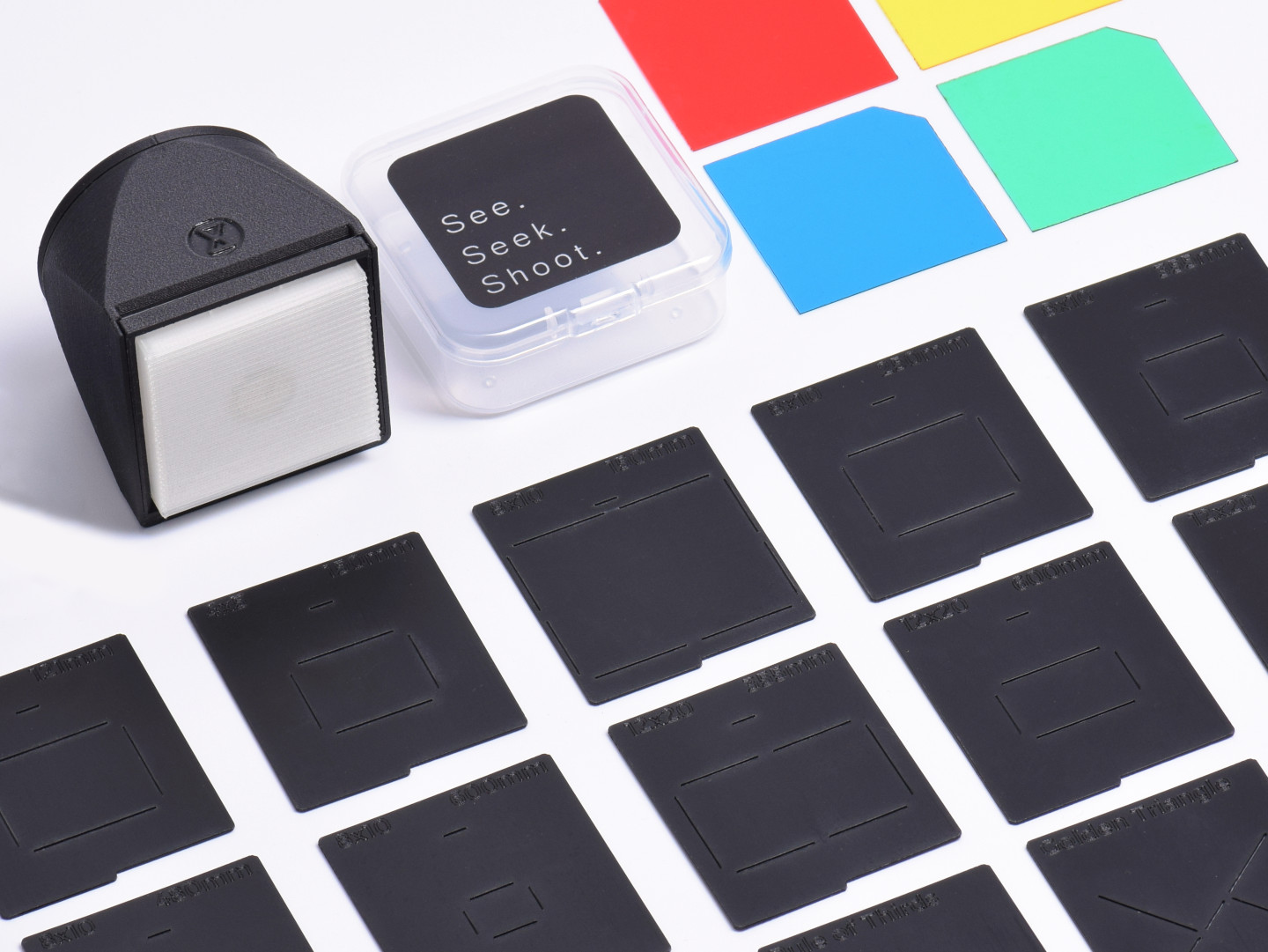
Forma modular optical viewfinder with interchangeable laser-cut frameline cards, coloured contrast gels, and storage case.

Why I Built Forma – Reimagining a 75-Year-Old Viewfinder

By Peter Modzelewksi

After more than a year of development, I’m excited to share Forma, a modular, multi-format optical viewfinder that can be tailored to your exact lenses and shooting formats—helping you find your frame before you set up, scout more efficiently, and shoot with greater confidence.

Inspired by the 75-year-old Voigtländer Kontur, Forma uses the same principle of binocular fusion, taking advantage of your brain’s ability to merge what each eye sees into a single image. One eye looks directly at the scene, while the other looks through the viewfinder which displays only bright framelines against a black background. The result is framelines that appear to float over the real world—essentially a form of augmented reality using our own natural vision.
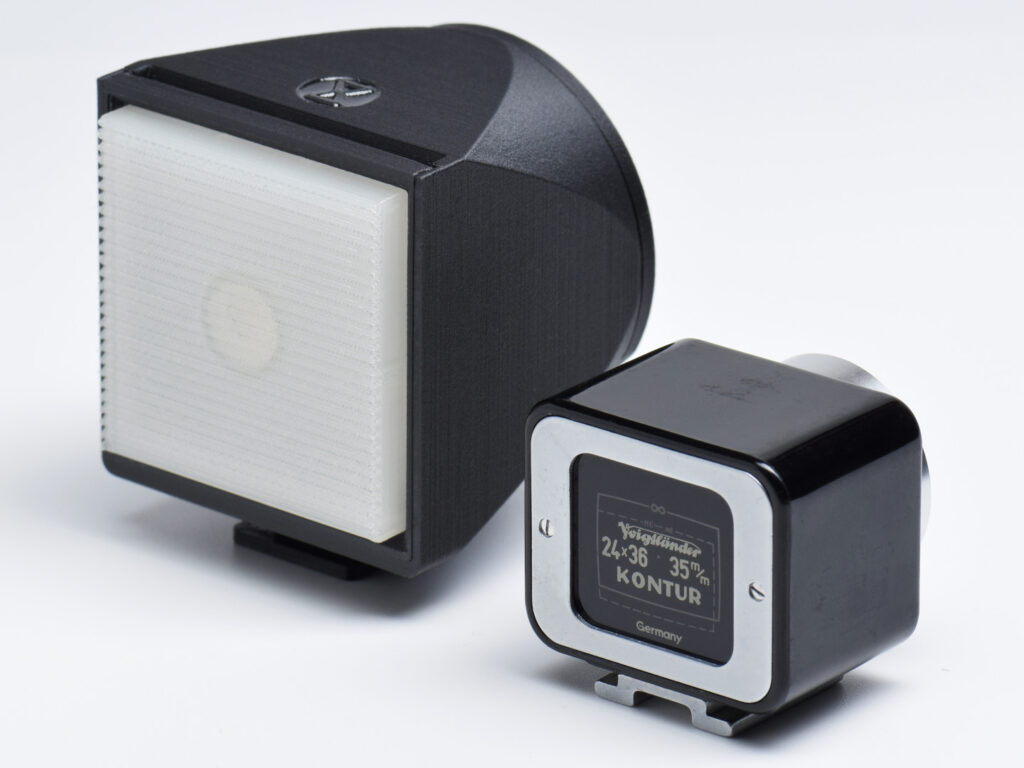
Forma and the Voigtländer Kontur, side by side
Forma with its quick-release shoe mount fitted, alongside the Voigtländer Kontur.

What makes Forma different is its interchangeable, laser-cut frameline cards, which can be swapped in seconds to accommodate virtually any photographic or cinema format, with fields of view as wide as a 24mm lens on 35mm film. The framelines can also be illuminated and colour-tinted with interchangeable gels, making them easily visible in a wide range of lighting conditions.
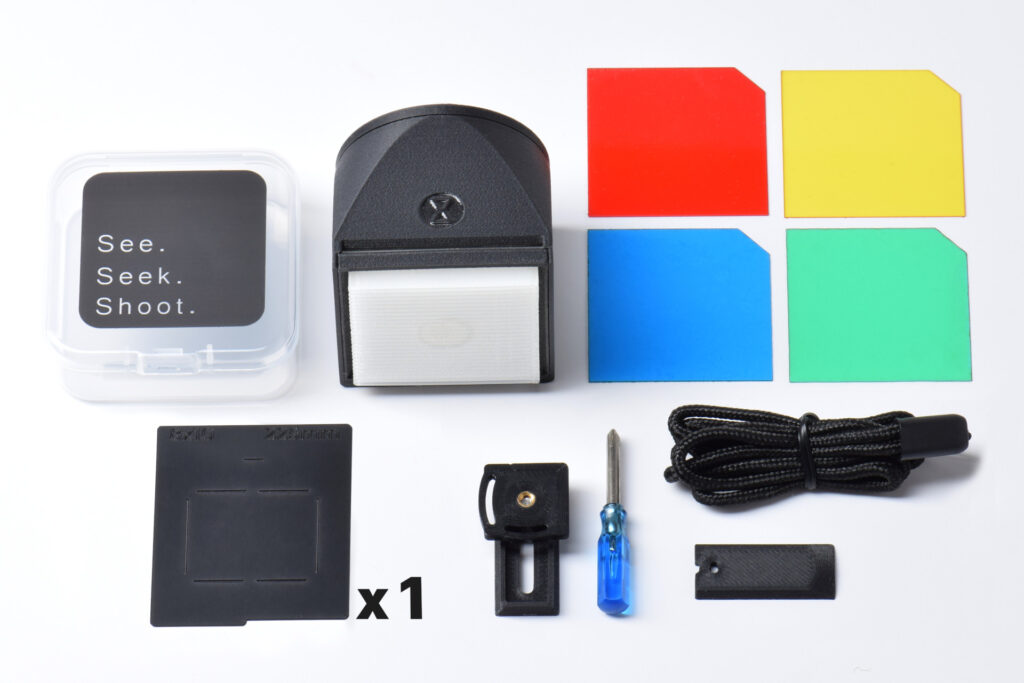
Complete Forma optical viewfinder kit with custom frameline card, coloured contrast gels, neck strap, mounting accessories, and screwdriver.
Complete Forma Kit, including one custom-made frameline card.

Today, November 10, I’m finally launching Forma on Kickstarter to share it with fellow photographers. Early-bird kits start at CA$55 (approximately US$40) and include one custom laser-cut frameline card made for your chosen lens and shooting format.

I designed Forma to help me find compositions more efficiently and make more intentional and confident photographic choices. I wanted a tool that would not only help me decide when to reach for my camera and where to set it up, but also train my eye across the different formats and lenses I shoot with, strengthening my own photographic vision.

I’d been thinking about creating a framing tool for years. As I progressed through the different film formats, from 35mm to medium format and then 4×5, I kept imagining something simple, analog, and adaptable. Something that would help train my photographic vision while allowing me to experience the scene naturally, with my own eyes.

Smartphone apps pulled me away from an analog process, while conventional universal viewfinders were bulky and felt like looking through a tunnel. Neither offered the experience I wanted.
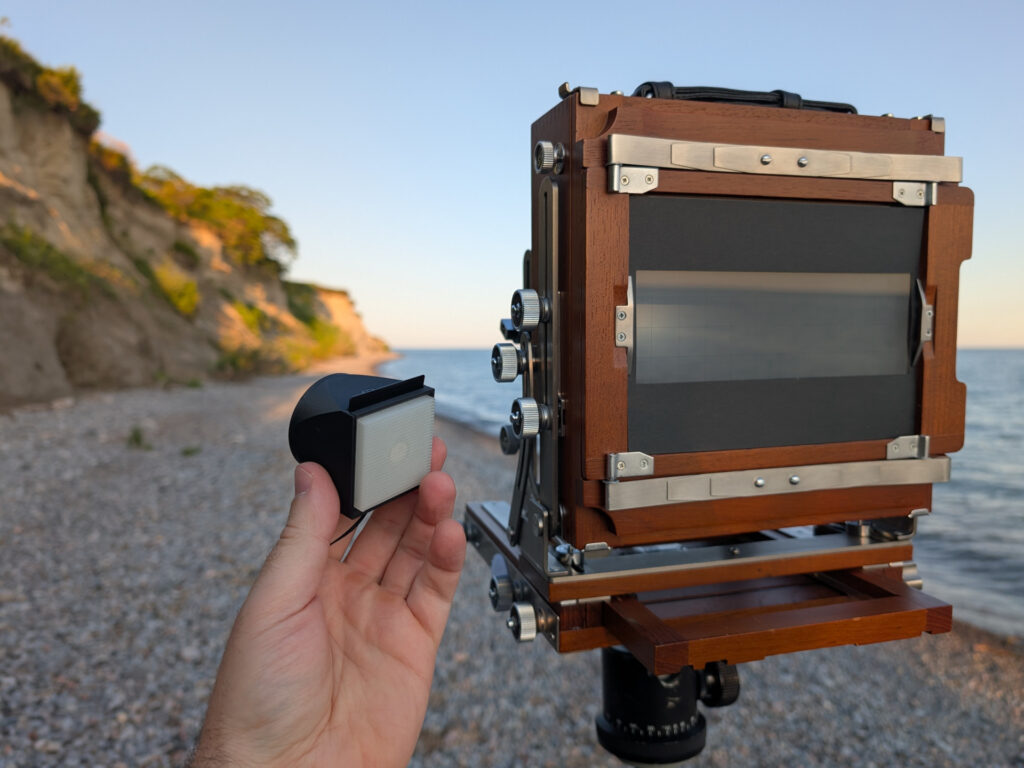
Shooting a 6x17 panorama on 5x7 film after finding my framing with Forma.
Shooting a 6×17 panorama on 5×7 film after finding my framing with Forma.

It wasn’t until I started shooting 5×7 that the desire became a genuine need. The camera was bigger and heavier, took longer to set up, and was much more cumbersome to reposition. I needed something that could quickly and easily answer questions such as, “Where’s the best spot to place my tripod?”, “Which lens should I go with?”, and even something as fundamental as, “Is this even worth setting up for?”

So, after years of thinking about it, I finally decided to make something myself.

My first attempt was embarrassingly crude. It was a wooden frame that took me about ten minutes to make. It had a series of special markings indicating how far I should hold the frame from my eye to approximate different focal lengths. This was the “breakthrough” idea I’d kept in the back of my mind for several years.
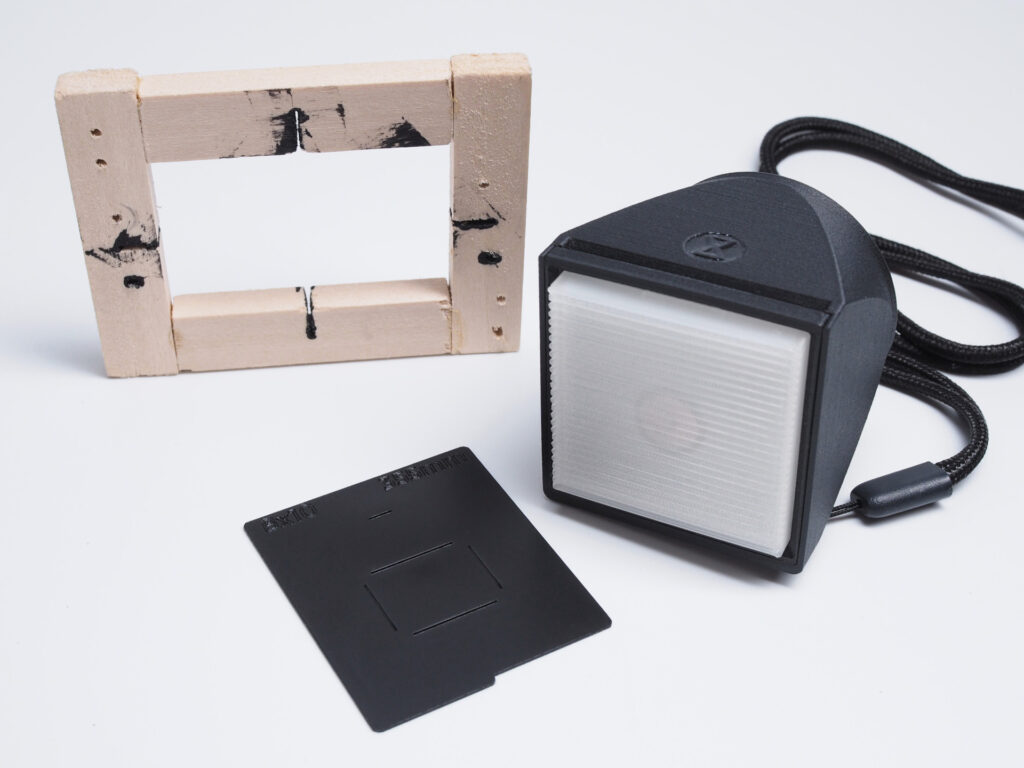
My initial wooden frame prototype next to Forma.
My original wooden prototype after ten minutes of tinkering, and Forma after a year of development and countless revisions.

However, after building the prototype and testing the idea in its simplest form, I realized that the concept simply wouldn’t work in practice. When the frame was held close to my eye, it was impossible to keep both the markings and the scene in focus. Not to mention, positioning the frame correctly required far too much effort.

What I did like, however, was being able to look directly at the scene with my naked eye. I just needed something that worked instantly, stayed sharp, and felt intuitive to use.

I decided to keep going.

I remembered the Ricoh Super Ricohflex I once owned. It was a medium-format TLR released in 1956, with an eye-level sportsfinder built into its waist-level viewing hood, operating on the same principle.
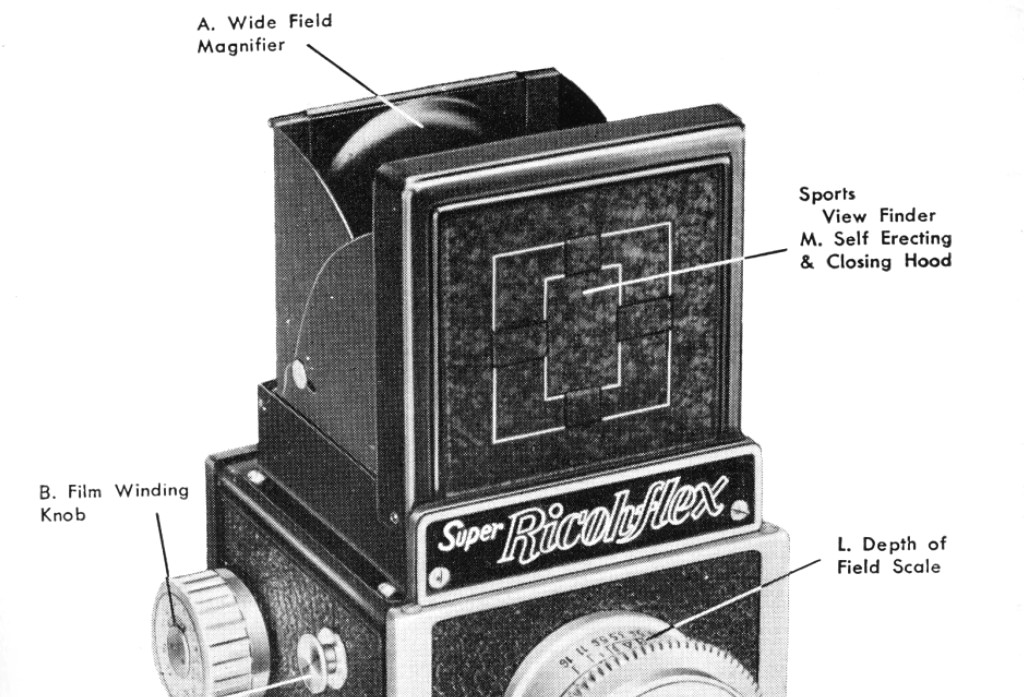
Diagram showing the sport viewfinder on the Ricoh Super Ricohflex
Ricoh Super Ricohflex sports viewfinder which also uses the principle of binocular fusion.

When I first tried it, I looked through it as I would a normal viewfinder and saw nothing but bright framelines against a black background. “Great, this viewfinder is broken,” I thought, assuming a mirror or some other part was missing. But then I opened my other eye, and suddenly the framelines appeared to float over the real world. I paused for a moment, completely blown away. So THIS was how it was supposed to work! Such a simple idea, yet so incredibly effective.

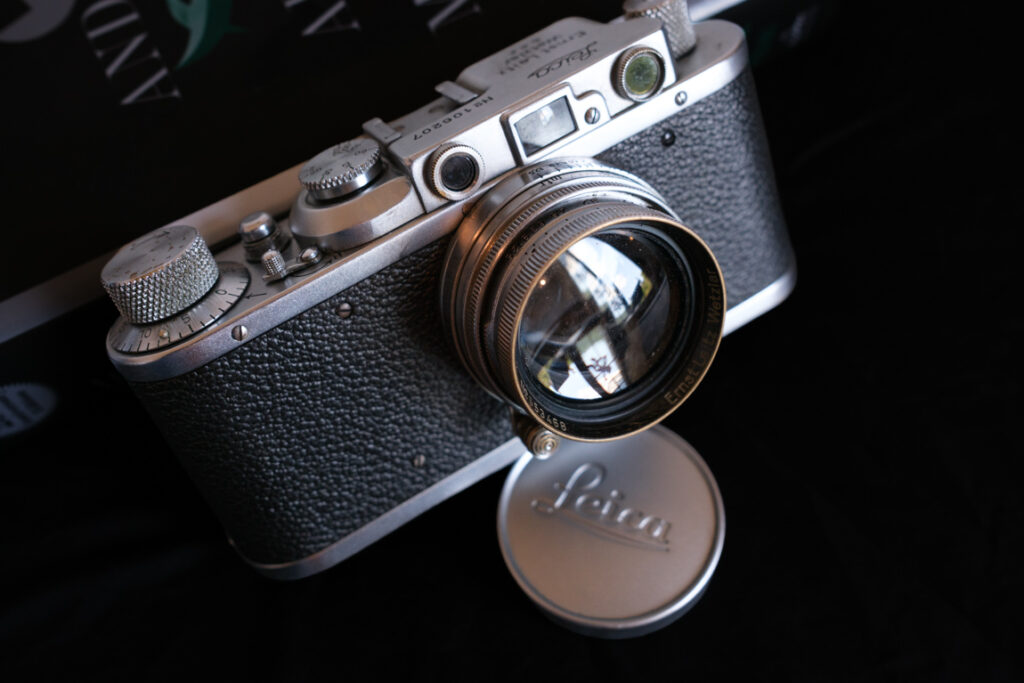
Years later, as my camera collection and knowledge grew, I learned that Voigtländer had also created a dedicated accessory viewfinder called the Kontur. Introduced in 1951, it came in versions for 35mm, 6×6, and 6×9, each designed around a particular format and focal length.

I knew this principle would be perfect for the framing tool I wanted to create, but I really didn’t want to recreate the Kontur. In fact, I initially resisted using the principle altogether. I wanted to create something completely unique, which I think is something any artist can relate to. Eventually, though, I realized that creating the right tool for the job was more important than being innovative simply for the sake of innovation. So I decided to reimagine the viewfinder Voigtländer had created 75 years earlier.

I started thinking about exactly what I wanted from this viewfinder and began sketching out some ideas.

I wanted interchangeable, durable framelines—so thin, laser-cut plastic cards seemed like the obvious solution. I wanted to cover lenses as wide as 24mm in 35mm terms—so I’d need optics capable of accommodating such a wide field of view. I wanted the framelines to remain visible in different lighting conditions—so some form of illumination and perhaps a way to colour-tint them. And I wanted to wear it around my neck or mount it securely on my camera—so a quick-release system seemed essential.

The problem was that I couldn’t simply build all of this from scraps of wood, and I certainly didn’t have the budget to hire a designer. What I did have, however, was enough motivation to figure out how to make it myself.

The first thing I did was download FreeCAD, a free CAD program, and start watching YouTube tutorials to learn how to use it. The next day, I bought a 3D printer, and before long, I was making my first crude parts. I knew I’d eventually need to learn laser cutting as well, but I didn’t want to get overwhelmed by thinking too far ahead. I decided to tackle one challenge at a time.

I ordered a variety of optics and began experimenting. Some had a field of view that was too narrow, while others were wide enough but didn’t provide the immersive viewing experience I wanted. Once I’d found an optic that could accommodate my target of 24mm-equivalent framelines, I could begin designing the body, interchangeable card system, illumination, and everything else I’d envisioned.

After several iterations, however, I was ready to give up. I’d come close to creating something useful, but what I really wanted still felt frustratingly out of reach, and I began questioning whether I had the patience to learn the skills I needed to pull it off.

I told myself I’d give it two more iterations.

After the first, I finally had a viewfinder that genuinely worked the way I wanted it to. And after the second, I had what would become Forma.
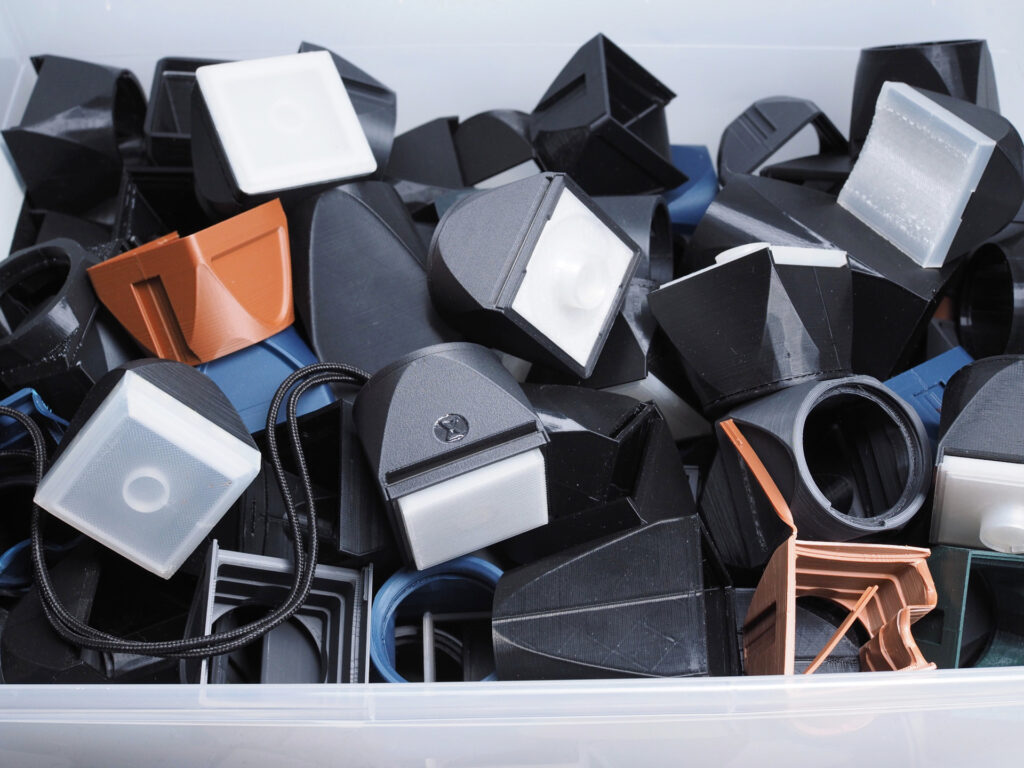
Forma in its final form, sitting atop dozens of earlier prototypes.

One of the breakthrough experiences I had while testing Forma was on a foggy winter walk near Toronto. I had brought my Voigtländer Bessa 466, a tiny folding medium format camera, and was using Forma to scout compositions.

While exploring near a bluff, I raised Forma to check a few potential photographs. Within seconds, I’d ruled them out—faster than I could have pulled my camera from my pocket. But instead of lowering it, I kept it to my eye and continued walking, scanning the shoreline through the framelines. Before long, I found a composition that spoke to me—one I probably wouldn’t have noticed otherwise.

That’s when I realized Forma wasn’t just a faster way to preview a photograph. It allowed me to actively explore a scene, discovering compositions as I moved through it—letting the framelines guide my eye.
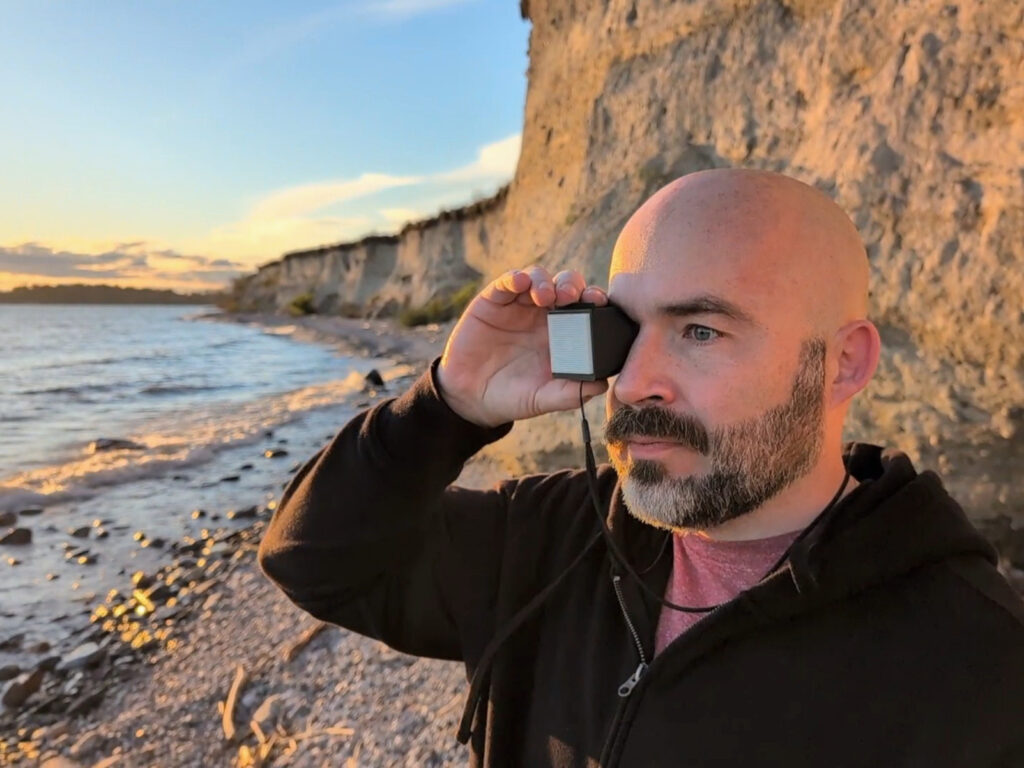
Scouting compositions by the shore of Lake Ontario with Forma.
Scouting compositions and training my photographic eye with Forma.

Now I bring Forma with me on casual hikes and walks where I’d normally leave my camera at home. If something catches my eye, I can explore the composition and return with a camera if it’s worth photographing—all while continuing to develop my photographic vision.

It wasn’t easy, but I genuinely feel it was worth it. I’ve sent pre-production units of Forma to photographers around the world, including Japan and the UK, and their feedback has been incredibly rewarding. Knowing something I created is helping other photographers discover new compositions, and making their photographic journey just a little more enjoyable, means a great deal to me.

I hope Forma does the same for you.

Back Forma on Kickstarter: Forma, A Universal Multi-Format Viewfinder
Learn more about Forma: oramodlab.com
Instagram: @oramodtools

Share this post:

About The Author

By Peter Modzelewksi
Peter Modzelewski is a film photographer and maker based in Ontario, Canada. Passionate about vintage cameras, unusual optics, and large-format photography, he enjoys experimenting with photographic equipment and finding creative solutions to technical challenges. He's also the creator of Forma, a modular optical viewfinder designed to help photographers explore new compositions.
Read More Articles From Peter Modzelewksi

Find more similar content on 35mmc

Use the tags below to search for more posts on related topics:

Donate to the upkeep, or contribute to 35mmc for an ad-free experience.

There are two ways to contribute to 35mmc and experience it without the adverts:

Paid Subscription – £3.99 per month and you’ll never see an advert again! (Free 3-day trial).

Subscribe here.

Content contributor – become a part of the world’s biggest film and alternative photography community blog. All our Contributors have an ad-free experience for life.

Sign up here.

Make a donation – If you would simply like to support Hamish Gill and 35mmc financially, you can also do so via ko-fi

Donate to 35mmc here.

Comments

Christian on Why I Built Forma – Reimagining a 75-Year-Old Viewfinder

Comment posted: 10/11/2026

Interesting idea Peter!
Seeing your picture where you hold your gadget against your eye, I'm wondering if it can work well with glasses.
I know these "viewfinder" apps for smartphones, but never used one of these..
However I'm wishing you great success with your project, looks like you really perfected this gadget out to the max...
Reply

Leave a Reply

Your email address will not be published. Required fields are marked *

Peter Modzelewksi replied:

Comment posted: 10/11/2026

Hi Christian! Thank you for your kind words! Forma will work with glasses. However, wearing glasses may limit how wide a field of view you'll be able to see. From my own testing, the widest focal lengths currently supported with glasses on are approximately 25mm on 35mm, 50mm on 6×6, 90mm on 4×5, and 190mm on 8×10. These limits may vary slightly depending on the distance between your eye and Forma. Please let me know if you have any other questions!

Reply

Leave a Reply

Your email address will not be published. Required fields are marked *

Justin on Why I Built Forma – Reimagining a 75-Year-Old Viewfinder

Comment posted: 10/11/2026

Interesting work! I thought of altering one of the original Kontur viewfinders so it would have a wider view, but I never got very far. This seems more elaborate and useful though. Bravo!
Reply

Leave a Reply

Your email address will not be published. Required fields are marked *

Peter Modzelewksi replied:

Comment posted: 10/11/2026

Hi Justin! Thank you for the kind words! The Kontur was such a great concept for a viewfinder. I wonder if the optics available at the time simply didn't allow it to support wider lenses. I did my best to make Forma a worthy successor!

Reply

Leave a Reply

Your email address will not be published. Required fields are marked *

Michael McGrath replied:

Comment posted: 10/11/2026

Hi Peter, A great piece, I was going to ask the same question as Justin! I think Iwill ahve to try it out! Michael.

Reply

Leave a Reply

Your email address will not be published. Required fields are marked *

Peter Modzelewksi replied:

Comment posted: 10/11/2026

Hi Michael, thank you, I really appreciate that! I hope you get a chance to try it and thank you for your interest!

Reply

Leave a Reply

Your email address will not be published. Required fields are marked *

Hamish Gill on Why I Built Forma – Reimagining a 75-Year-Old Viewfinder

Comment posted: 10/11/2026

Let me know when you're ready, I would love to reiew one of these for the website!
Reply

Leave a Reply

Your email address will not be published. Required fields are marked *

Peter Modzelewksi replied:

Comment posted: 10/11/2026

Hi Hamish! I'd love for you to review one. I'll shoot you an email and you can let me know the formats and focal lengths you'd like covered. Thanks again!

Reply

Leave a Reply

Your email address will not be published. Required fields are marked *

Adrian Riu on Why I Built Forma – Reimagining a 75-Year-Old Viewfinder

Comment posted: 10/11/2026

Looks like a lot of work paid off. How small would the frames appear for something like 75mm (in 35mm format); i.e., what is the magnification?
Reply

Leave a Reply

Your email address will not be published. Required fields are marked *

Peter Modzelewksi replied:

Comment posted: 10/11/2026

Hi Adrian! Thank you! The beauty of Forma is that the view is life-size (1:1 magnification), regardless of the focal length you're using. So with a 75mm lens on 35mm format, the framelines would simply appear smaller within your natural field of view, rather than magnifying or shrinking the scene itself (since you're using your naked eye to frame the actual scene). Hope that explains it well. Please let me know if you have any other questions!

Reply

Leave a Reply

Your email address will not be published. Required fields are marked *

Adrian Riu replied:

Comment posted: 10/11/2026

Yes, that makes perfect sense. I joined the Kickstarter. And as to the question of what modifications, I think a slot on the side where one can hold an extra card would be nice. I can mould one out of sugru, but having one buil-in would certainly look better.

Reply

Leave a Reply

Your email address will not be published. Required fields are marked *

Peter Modzelewksi replied:

Comment posted: 10/11/2026

I appreciate you joining and support the campaign. That is a great idea as well. You know what? I can maybe make a card holder that mounts to Forma using the quick-release dovetail slot. It could hold 1-2 cards and still have a spot for the neck strap to attach to. What do you think?

Reply

Leave a Reply

Your email address will not be published. Required fields are marked *

Michael Flory on Why I Built Forma – Reimagining a 75-Year-Old Viewfinder

Comment posted: 11/11/2026

This seems one of those rare inventions that are so evident, in retrospect, that you wonder why it wasn't done ages ago... but it wasn't! It's the ultimate 100%-size viewing system, and I'm a big fan of those from using my Konica IIIa. I've just signed up on Kickstarter. For me it comes at a very opportune time, as I'm working on a homebrew medium-format panoramic camera, attempting to graft a 65mm F8 Super-Angulon onto a Loma 120WPC, a toy-like pinhole camera that just happens to have a 6x12cm image size and reliably winds 120 film, but which has no viewfinder. (Before sacrificing it I've run a couple of rolls through it using the pinhole, with truly awful results!) On the Kickstarter page I didn't see how to specify what mask I'd like with it, but I guess that can be sorted out.
Reply

Leave a Reply

Your email address will not be published. Required fields are marked *

Peter Modzelewksi replied:

Comment posted: 11/11/2026

Hi Michael! Thank you so much for the kind words and for backing Forma! The original Kontur was a brilliant concept, it doesn't get much more clear than a naked eye for framing. Your panoramic camera project sounds awesome. I'd love to see the finished camera with Forma mounted on top! I've also made a note that you're looking for a 6×12 frameline card for a 65mm lens. Once the Kickstarter campaign ends, I'll be sending out a survey to collect everyone's preferred formats and focal lengths. So if you decide to change your specifications, you'll have an opportunity to do so then. Thanks again for your support, Michael, and best of luck with the camera build!

Reply

Leave a Reply

Your email address will not be published. Required fields are marked *

Michael Flory on Why I Built Forma – Reimagining a 75-Year-Old Viewfinder

Comment posted: 11/11/2026

Peter, thank you for the reply. I just read your email requesting further suggestions from everyone. My first thought would be some sort of parallax correction without flipping the card, but I suspect it would make the design far more complicated. What about adding marked parallax notches to the basic frame outline, like those some cameras without any other parallax correction have?

I'll have to find a Kontur somewhere. People speak well of them and I'd never heard of them. (I used to have a Ricohflex but I don't think it had that clever etched finder cover.) You may regret asking to see the Forma on my Holgenstein, it's going to be an ugly contraption and I'm ashamed to think of debasing the elegant Forma in such a way! One of my next steps is to improvise and properly align a cold shoe on the Holga's top plate. I suspect any shoe I steal from a parts camera will mate properly with the Forma's "dual-profile" shoe, which looks like a clever invention in itself.
Reply

Leave a Reply

Your email address will not be published. Required fields are marked *

Peter Modzelewksi replied:

Comment posted: 11/11/2026

I like your idea of having parallax correction notches marked directly on the card. That would certainly work, and might even be a faster solution than flipping the card. The tradeoff would be a slightly more cluttered view, which some photographers might find perfectly acceptable depending on how they use Forma. One thing I discovered while developing the frameline cards is that having too many markings can actually interfere with binocular fusion. Your brain seems to struggle to merge the images from both eyes, and the framelines don't quite want to settle into the scene you're viewing. The Voigtländer Kontur actually has dashed markings for parallax correction alongside the standard framelines, and I find that looking through it doesn't feel quite as natural as viewing a single, clean set of framelines. It's an interesting tradeoff, and something worth exploring. I'd love to see Forma on your Holgenstein! It's actually hilarious because I have a Holga sitting on my shelf, and Forma looks perfect on it. :) And yes, the dual-profile shoe should fit pretty much any camera with an accessory shoe. I have a giant box of parts cameras in my basement, and I made sure to test it on every single one of them, including a few digital point-and-shoots.

Reply

Leave a Reply

Your email address will not be published. Required fields are marked *

Nick Orloff on Why I Built Forma – Reimagining a 75-Year-Old Viewfinder

Comment posted: 11/11/2026

A great idea Peter, I've I've backed your kickstarter.

I've been playing around with 6 x 17 and 6 x 12, so I've ordered a dual frameline card to go with the kit.

Looking forward to testing it out!
Reply

Leave a Reply

Your email address will not be published. Required fields are marked *

Peter Modzelewksi replied:

Comment posted: 11/11/2026

Hi Nick, Amazing, I really appreciate you backing the Kickstarter! Panoramic formats are a great way to switch things up. I'm looking forward to getting it in your hands. Thank you again, Peter

Reply

Leave a Reply

Your email address will not be published. Required fields are marked *

Christian Hogue on Why I Built Forma – Reimagining a 75-Year-Old Viewfinder

Comment posted: 14/11/2026

there are a few phone apps that do this for pro cinematographers, but they might not cover the LF aspects though.. a analog solution is always a nice option however so well done..
Reply

Leave a Reply

Your email address will not be published. Required fields are marked *

Peter Modzelewksi replied:

Comment posted: 14/11/2026

Hi Christian, thank you for the kind words! That's exactly it. For me personally, I wanted an analog solution that felt like a natural extension of my analog photography process.

Reply

Leave a Reply

Your email address will not be published. Required fields are marked *

Leave a Comment

Leave a Reply

Your email address will not be published. Required fields are marked *